
Table of Contents
- Best Tips for Giving a Class Presentation
- Unique Topics for Presentation in School
- Research and Outline Your Speech
- The Perfect School Presentation Outline
- How do I get over the fear of presenting in class?
- How Long Should a School Presentation Be?
- How can I make my presentation stand out?
- Best School Presentation Templates and Websites
- Do I have to memorize my school presentation?
- Conclusion: From Nervous to Notorious (in a Good Way!)
How to Prepare for a School Presentation: A Step-by-Step Guide
Best Tips for Giving a Class Presentation
Feeling nervous about standing up in front of your class to speak? You are not alone! Almost everyone gets a little anxious before public speaking. But here is the secret: knowing how to prepare for a school presentation makes all the difference.
Whether it is a science project, a history report, or an English assignment, being well-prepared turns fear into confidence. In this guide, we will walk through everything you need to know, from picking the best topic to designing awesome slides.
Unique Topics for Presentation in School
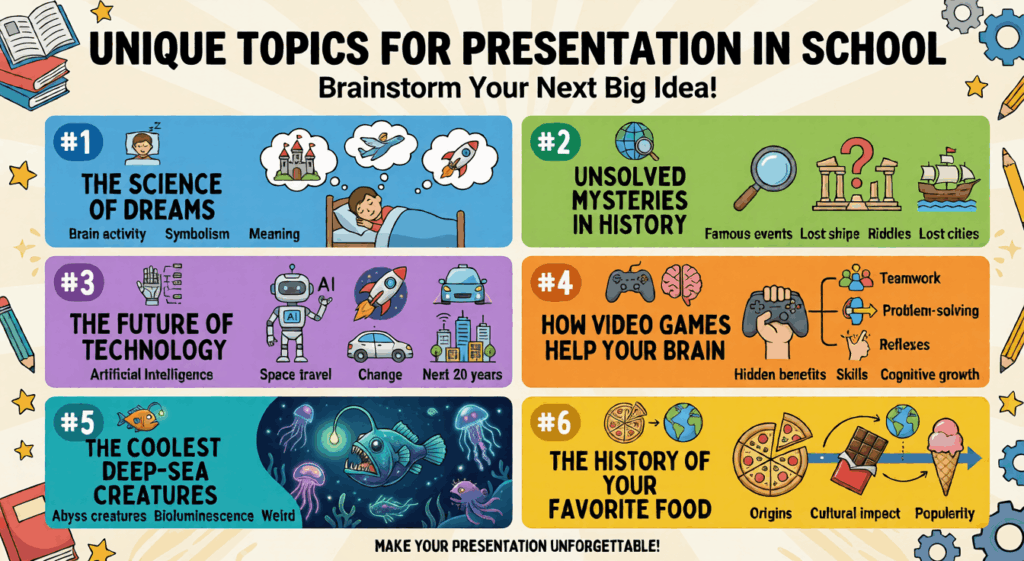
Choosing the right topic is the secret to a stress-free presentation. If you pick a subject you actually care about, the research will feel like fun instead of homework. Plus, when you are genuinely interested in what you are talking about, your energy will naturally shine through. This keeps your classmates awake and guarantees a better grade from your teacher!
Whenever you have the freedom to pick your own subject, do not just choose the easiest option. Think about your hobbies, questions you have always wanted to answer, or strange facts you have read online.
If you are staring at a blank piece of paper and struggling to brainstorm, do not worry. Here are a few unique and exciting ideas that are sure to grab everyone’s attention:
- The Science of Dreams: Why do we dream every night, and do those dreams actually mean anything?
- Unsolved Mysteries in History: Explore famous historical events, lost ships, or ancient cities that still confuse experts today.
- The Future of Technology: How will artificial intelligence, smart robots, and space travel change our daily lives in the next twenty years?
- How Video Games Help Your Brain: The hidden benefits of playing video games, like better teamwork, faster reflexes, and improved problem-solving skills.
- The Coolest Deep-Sea Creatures: A look at the weirdest, glow-in-the-dark, and most fascinating animals that live in the darkest parts of the ocean.
- The History of Your Favorite Food: Where did pizza, chocolate, or ice cream actually come from, and how did it become so popular?
Research and Outline Your Speech
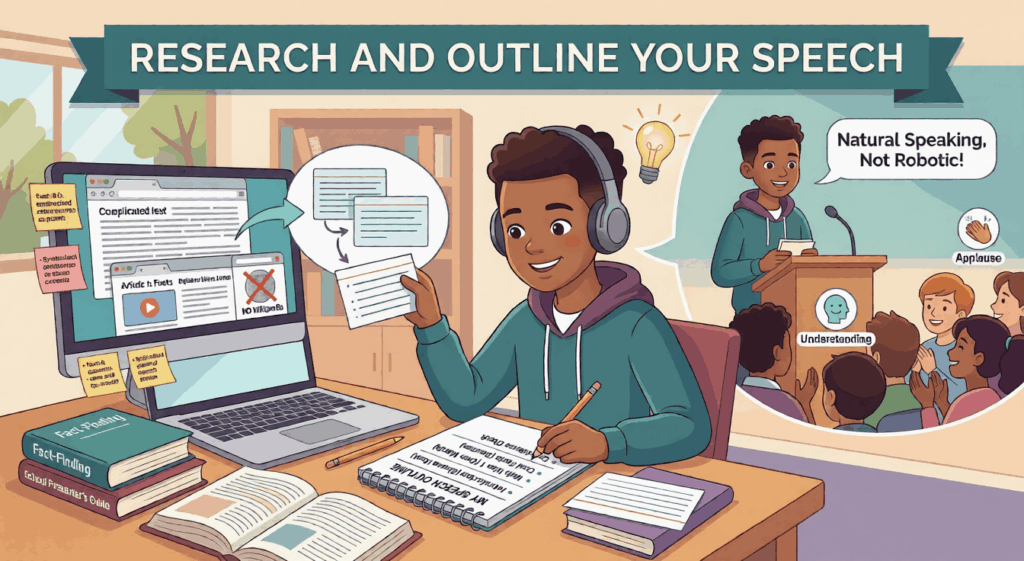
Once you have your perfect topic, it is time to gather your facts. A great presentation is built on solid research, but you want to make sure you are explaining things in a way your classmates will understand.
When you look up information online, read a few different articles or watch a few educational videos. Do not just copy and paste from Wikipedia! Read the facts, close the tab, and then write down the most interesting points in your own words. This helps you actually learn the material so you will not sound like a robot reading from a script.
The Perfect School Presentation Outline
You do not need to write a massive essay. The easiest way to organize your research is to build a simple outline. Every great school presentation follows this exact three-part structure:
- The Introduction (10% of your speech): Start with a “hook” to grab attention right away. This could be a surprising fact, a funny short story, or a question you ask the audience. Then, briefly tell them what you will be talking about today.
- The Body (80% of your speech): This is the main part of your presentation. Keep it simple by focusing on just three main points. Share your research, explain why it matters, and use examples.
- The Conclusion (10% of your speech): Never just say, “And yeah, that is it.” Wrap up your speech by quickly summarizing your three main points and leaving the class with one final, memorable thought.
How do I get over the fear of presenting in class?
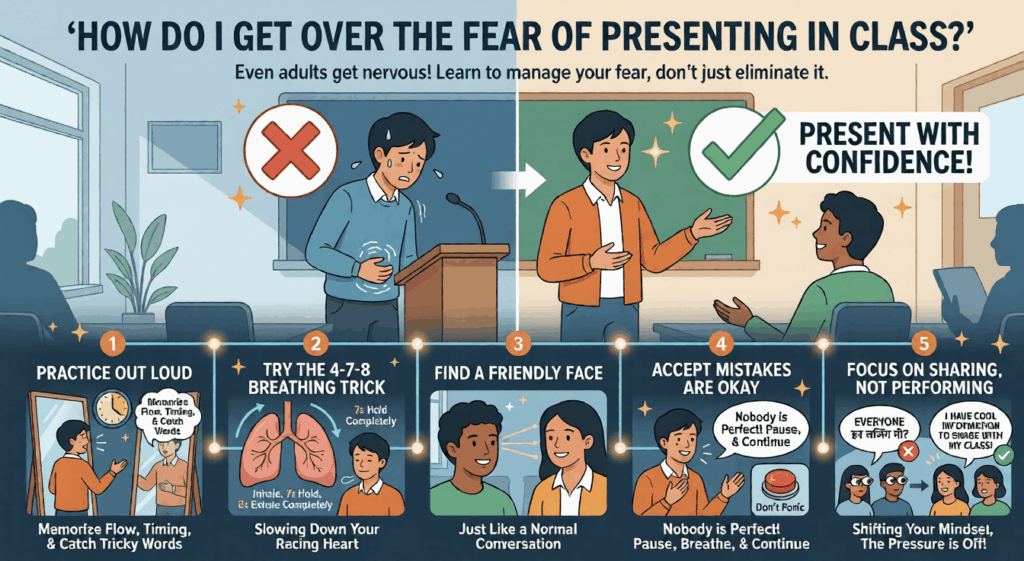
It is completely normal to feel a knot in your stomach before speaking in front of the class. Even adults get nervous before big presentations! The trick is not to make the fear disappear completely, but to learn how to manage it so it does not hold you back.
Here are a few proven ways to calm your nerves and present with confidence:
- Practice out loud: Reading your notes silently in your head is very different from actually speaking them. Practice your entire presentation out loud in your bedroom, in front of a mirror, or to your family. Hearing your own voice helps you memorize the flow, find the right timing, and catch any tricky words before the real thing.
- Try the “4-7-8” breathing trick: Before you walk to the front of the room, inhale quietly through your nose for 4 seconds, hold your breath for 7 seconds, and exhale completely through your mouth for 8 seconds. This physically slows down your racing heart.
- Find a friendly face: Do not stare at the floor or the back wall. Find one or two friends in the classroom who make you feel comfortable and make eye contact with them while you speak. It will feel like you are just having a normal conversation.
- Accept that mistakes are okay: If you stumble over a word or lose your place, do not panic! Just pause, take a breath, look at your notes, and keep going. Nobody in the audience expects you to be absolutely perfect.
- Focus on sharing, not performing: Shift your mindset. Instead of thinking, “Everyone is judging me,” think, “I have some really cool information to share with my class.” Focusing on your topic takes the pressure off of yourself.
How Long Should a School Presentation Be?
Most standard school presentations usually last between three to five minutes, though you should always check your teacher’s specific assignment guidelines first. This timeframe is the perfect sweet spot because it gives you enough room to clearly share your introduction, three main points, and a solid conclusion. Speaking for too long might cause your classmates to lose focus, while finishing too quickly could make it look like you did not do enough research.
To make sure you hit that exact time window, it is incredibly important to time yourself while you are practicing at home. Simply grab your phone, open the stopwatch app, and run through your entire speech out loud at a normal, relaxed pace. If you find yourself rushing to beat the clock, try cutting out a few extra details so you can speak clearly without feeling breathless.
How can I make my presentation stand out?
It is easy for classmates to zone out if a presentation is just someone reading a boring script. If you want to grab their attention, earn top marks, and make your speech truly memorable, you have to add a little extra effort to how you present.
Here are a few actionable tips to make your school presentation the best in the class:
- Start with a strong hook: Never begin by just saying, “My presentation is about…” Instead, instantly grab your audience’s attention by opening with a shocking statistic, a funny short story, or a “what if” scenario.
- Ask your audience questions: Keep your classmates engaged by asking for a quick show of hands or asking a simple question they can relate to. This turns a boring lecture into a fun, two-way conversation.
- Use high-quality SlideChef templates: Nobody likes staring at a plain white screen filled with tiny text. Upgrade your visual aids by using a professionally designed, easy-to-edit template from SlideChef. Having a beautiful, colorful slideshow makes you look incredibly prepared and confident.
- Speak with enthusiasm: Your voice is your best tool. Change up your volume, use hand gestures, and smile. If you sound genuinely excited about your topic, your classmates will automatically feel more interested in what you have to say.
Best School Presentation Templates and Websites
Nobody wants to stare at a boring black-and-white screen while you speak! Your slides should be helpful visual aids, not a script that you read word-for-word. Having a colorful, well-designed slideshow instantly makes your project look professional and keeps your classmates glued to your presentation.
Instead of spending hours trying to design slides from scratch, the smartest trick is to use pre-made templates. For the absolute best designs, SlideChef is the ultimate website for students.
Here are the best school presentation templates you can use for your next big project:
Science Presentation Template

Perfect for biology, chemistry, or physics projects. These templates usually feature cool science icons, clean charts for your data, and a futuristic layout that makes your experiment look incredibly professional.
History Timeline Template

Got a big history report? This template makes it easy to show a sequence of events. It uses vintage colors and built-in timeline graphics so your classmates can easily follow along with the historical story you are telling.
Animated Classic Chalkboard Template

If you want a fun, traditional school vibe, this is a favorite! It features a chalkboard background with chalk-style fonts and playful doodles, making it great for almost any general class assignment.
Reporting Presentation Template by SlideBazaar
If your school project requires a more formal or data-heavy approach, the library at Slidebazaar is a goldmine. They offer every style of reporting template imaginable—from simple progress reports to complex research findings. These templates are great because they come with professional layouts, clean data tables, and easy-to-read charts that make your information look organized and authoritative.
Professional Infographic Template
If your presentation has a lot of numbers, percentages, or survey results, then WinSlides Infographic Templates library is the perfect choice. It turns boring data into colorful pie charts, bar graphs, and cool graphics that are super easy to understand.
Vision Board Template by WinSlides
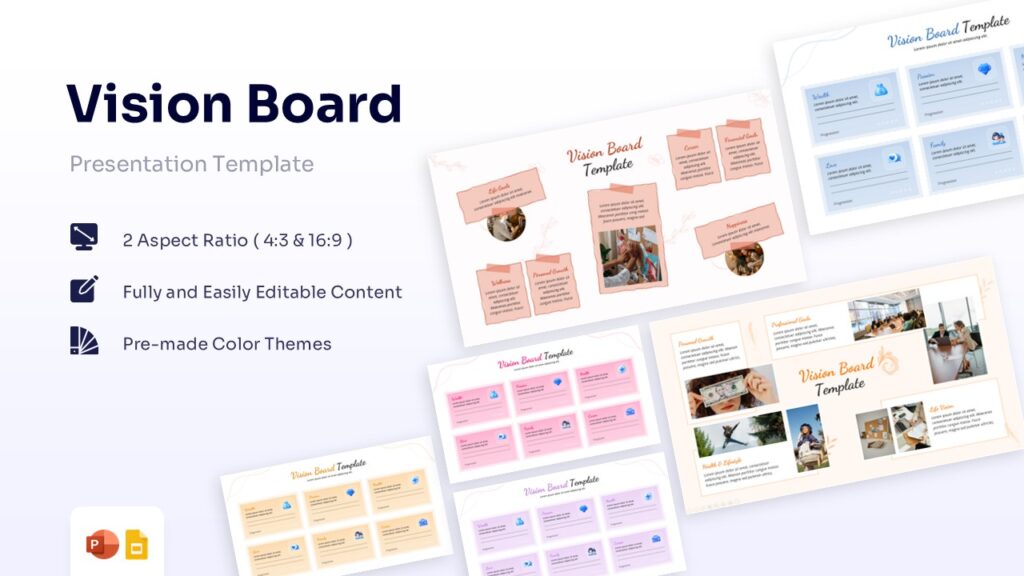
If your assignment involves personal development, goal-setting, or a creative end-of-year reflection, this vision board template from WinSlides is a fantastic choice. It features a highly aesthetic, inspiring layout with polaroid-style photo frames and sticky-note text boxes where you can map out your ideas. It comes with beautiful pre-made pastel color themes, is fully editable, and works perfectly in both PowerPoint and Google Slides.
Do I have to memorize my school presentation?
No, you absolutely do not have to memorize every single word of your speech! In fact, trying to recite a script word-for-word is usually a bad idea. It can make you sound robotic, and if you forget just one sentence, it is incredibly easy to panic and freeze up in front of the class.
Instead of stressing over memorizing paragraphs, your goal should be to understand your topic well enough to talk about it naturally. Here are 6 highly effective strategies to use instead of memorization:
- 1. Memorize Only the “Bookends”: Focus your memorization strictly on your very first two sentences (your introduction) and your last two sentences (your conclusion). Starting strong gives you immediate confidence, and ending smoothly leaves a great final impression on your teacher.
- 2. Use the Keyword Outline Method: Instead of writing out full sentences on your notes, write down a list of keywords or short phrases. If you are talking about the solar system, your note might just say “Jupiter – biggest, gas giant, red spot.” This forces your brain to build the sentence naturally on the spot.
- 3. Keep Flashcards as a Safety Net: Write your keyword outline on small index cards. The trick is to hold them loosely and only glance down at them if your mind goes blank. Never hide your face behind a large sheet of paper!
- 4. Let Your Slides Guide You: If you are using a great SlideChef template, the bullet points and pictures on your screen should act as visual reminders of what comes next. Just remember the golden rule: glance at the slide to remember your point, but always turn back to look at the class when you actually speak.
- 5. Explain It Like You Are Talking to a Friend: Shift your mindset. Imagine you are just sitting at lunch telling your best friend about this cool topic you researched. This helps you use your natural, conversational voice, which is much more engaging for the audience to listen to.
- 6. Practice the “Flow,” Not the Script: When you practice out loud at home, do not stop and start over if you use a different word than you planned. Practice pushing through mistakes. As long as the main idea flows from one point to the next, your audience will never know you changed a word!
Conclusion: From Nervous to Notorious (in a Good Way!)
Standing at the front of a classroom doesn’t have to feel like a survival mission. As you’ve seen, the “secret” to a great grade isn’t being a born public speaker—it’s simply having a solid plan. From picking a topic that actually excites you to using a professional SlideChef template to do the heavy visual lifting, you now have all the tools to turn that “knot in your stomach” into confident energy.
Remember, your classmates aren’t there to judge you; they’re there to learn something cool from you. By focusing on your research, practicing your “hook,” and using your slides as a guide rather than a crutch, you’ll stop performing and start sharing. Don’t leave your next big project to chance. Take these steps, grab your favorite template, and get ready to deliver a presentation your class will actually remember!
About The Author





Related Blogs