Table of Contents
- Guarantee Become Better Presenter than 92% People Out There
- What Is a Good Presenter? Key Qualities That Make a Great Presenter
- 15 Practical Tips on How to Become a Better Presenter
- Common Mistakes That Prevent You From Becoming a Better Presenter
- How to Practice and Improve Your Presentation Skills Every Day
- How to Become a Better Presenter at Work, School, or College
- Final Thoughts: Become a Better Presenter With Consistent Practice
How to Become a Better Presenter: 15 Practical Tips to Improve Your Presentation Skills

Guarantee Become Better Presenter than 92% People Out There
Think about the last presentation that truly caught your attention. What made it memorable? Was it the speaker’s confidence, the way they told a story, or how effortlessly they connected with the audience? That’s what makes a great presenter. It’s not just about standing in front of a room and talking through a set of slides; it’s about making people listen, understand, and remember what you say. Whether you’re presenting a college project, leading a business meeting, or pitching your next big idea, becoming a better presenter can make a real difference in how people perceive your message. And here’s the best part: you don’t have to be a natural-born speaker to do it. With the right techniques and consistent practice, anyone can become a confident and engaging presenter. Let’s explore 15 practical tips to help you improve your presentation skills and make every presentation count.
What Is a Good Presenter? Key Qualities That Make a Great Presenter
A good presenter is someone who can communicate ideas clearly, capture the audience’s attention, and make information easy to understand and remember. They don’t just stand in front of people and read from slides; they know how to connect with listeners, explain their message with confidence, and keep the presentation engaging from start to finish. Whether it’s a classroom speech, a business meeting, or a professional pitch, a great presenter combines strong communication skills, preparation, storytelling, and audience awareness to make every presentation meaningful.
Here are six important qualities that make someone a good presenter:
1. Clear and Confident Communication
A good presenter explains ideas in simple language without overwhelming the audience with unnecessary details. They speak at a comfortable pace, pronounce words clearly, and use the right tone to emphasize important points.
2. Strong Audience Connection
Great presenters understand that a presentation is more than a one-way conversation. They maintain eye contact, ask relevant questions, encourage participation, and adjust their delivery based on audience reactions.
3. Effective Storytelling
Stories make presentations more relatable and memorable. A skilled presenter uses real-life examples, personal experiences, and interesting scenarios to explain complex ideas and help the audience connect emotionally with the message.
4. Positive Body Language
The way you stand, move, and make eye contact can influence how people perceive your presentation. Good presenters maintain an open posture, use natural hand gestures, and show expressions that match their message.
5. Strong Preparation and Organization
An effective presenter plans their presentation before stepping in front of an audience. They organize information logically, prepare supporting visuals, rehearse their delivery, and make sure their key message is easy to follow.
6. Adaptability and Problem-Solving
Not every presentation goes according to plan. A good presenter can handle unexpected questions, technical difficulties, and changes in audience interest without losing confidence. They stay calm, think quickly, and adjust their approach when needed.
The key takeaway: Becoming a good presenter isn’t about being born with natural speaking talent. It’s about developing the right habits, practicing consistently, and learning how to communicate with your audience effectively.
15 Practical Tips on How to Become a Better Presenter
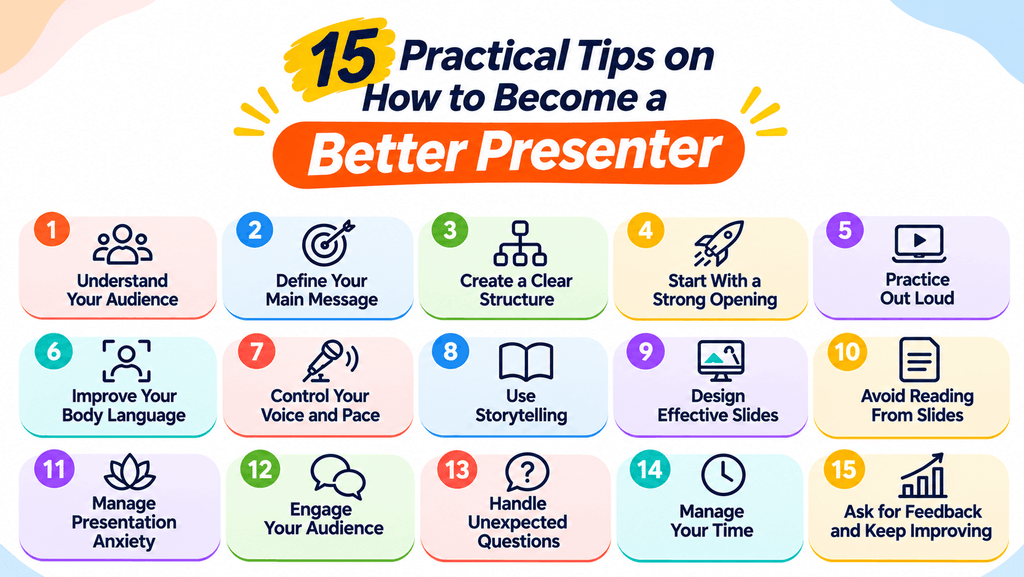
Becoming a better presenter doesn’t happen overnight, but small improvements in the way you prepare, communicate, and deliver your message can make a big difference. Whether you feel nervous speaking in front of others or simply want to make your presentations more engaging, developing the right habits can help you become a more confident speaker. Here are 15 practical tips you can start using to improve your presentation skills and make a lasting impression on your audience.
1. Understand Your Audience Before You Start
Before creating your slides or preparing your speech, take some time to understand who will be listening. Think about their interests, expectations, knowledge level, and what they want to learn from your presentation. A presentation designed for college students will look very different from one prepared for business executives or potential clients.
When you understand your audience, you can choose the right language, examples, visuals, and level of detail to make your message more relevant.
How to apply this tip:
- Identify who your audience members are and what they already know about the topic.
- Understand the main questions or problems they expect you to address.
- Use examples and stories that relate to their experiences.
- Adjust your presentation style and language to suit their knowledge level.
Remember: A great presentation isn’t just about what you want to say; it’s about what your audience needs to hear.
2. Define Your Main Message and Presentation Goal
Every successful presentation needs a clear purpose. Before preparing your content, ask yourself what you want your audience to learn, understand, or do after listening to you. Without a specific goal, it’s easy to include unnecessary information that distracts from your main message.
Try to summarize your entire presentation in one or two sentences. This will help you stay focused and decide which information deserves the most attention.
How to apply this tip:
- Set one primary objective for your presentation.
- Identify two or three important points that support your main message.
- Remove information that doesn’t contribute to your goal.
- End with a clear takeaway that your audience can remember.
3. Create a Clear and Logical Presentation Structure
A well-organized presentation makes it easier for your audience to follow your ideas. Instead of jumping between different topics, arrange your information in a logical sequence that takes listeners from the introduction to the conclusion.
A simple structure you can follow is:
- Introduction: Introduce your topic, explain why it matters, and capture attention.
- Main Content: Present your key arguments, supporting information, examples, and solutions.
- Conclusion: Summarize the important points and finish with a strong takeaway or call to action.
You can also use a simple storytelling approach: Problem → Explanation → Solution → Takeaway.
This gives your presentation a natural flow and prevents your audience from feeling lost.
4. Start Your Presentation With a Strong Opening
You have only a short time to capture your audience’s attention. Starting with a lengthy introduction or immediately reading the agenda can make your presentation feel predictable. Instead, open with something that makes people curious and encourages them to listen.
You can begin with:
- An interesting question that makes the audience think.
- A surprising statistic related to your topic.
- A short personal story or real-world example.
- A thought-provoking statement.
- A relatable problem your audience wants to solve.
For example, instead of saying, “Today, I’m going to talk about productivity,” try asking, “What if you could complete your most important work in less time without feeling overwhelmed?”
A strong opening creates curiosity and gives your audience a reason to stay engaged.
5. Practice Your Presentation Out Loud
Reading your presentation silently is not the same as delivering it in front of an audience. Practicing out loud helps you become familiar with your content, improve your speaking pace, and identify sentences that sound unnatural.
Don’t wait until the last minute to rehearse. Practice your presentation multiple times and try delivering it without constantly looking at your notes.
How to practice effectively:
- Rehearse your presentation from beginning to end.
- Practice in front of a mirror to observe your expressions and gestures.
- Record yourself to identify areas that need improvement.
- Use a timer to make sure you finish within the allotted time.
- Practice in front of friends or colleagues and ask for feedback.
The more familiar you become with your material, the more naturally you can deliver it.
6. Improve Your Body Language and Eye Contact
Your body language communicates just as much as your spoken words. Standing confidently, making natural gestures, and maintaining eye contact help you appear more approachable and trustworthy.
Avoid standing completely still, looking at the floor, or constantly shifting your weight. Instead, use relaxed movements that support what you’re saying.
Try these techniques:
- Maintain an upright and comfortable posture.
- Make eye contact with different people across the room.
- Use natural hand gestures to emphasize important points.
- Smile when appropriate to create a welcoming atmosphere.
- Avoid unnecessary movements that distract your audience.
Remember, confident body language doesn’t mean exaggerated gestures. Keep your movements natural and connected to your message.
7. Control Your Voice, Tone, and Speaking Pace
Speaking too quickly, too quietly, or in a monotonous voice can make even an interesting presentation difficult to follow. Good presenters understand how to use their voices to keep the audience interested and highlight important information.
Try changing your tone when introducing a new idea, slowing down when explaining something important, and using short pauses to let key points sink in.
How to improve your vocal delivery:
- Speak clearly and pronounce words properly.
- Avoid rushing through important information.
- Vary your pitch and tone to avoid sounding monotonous.
- Use pauses instead of filling every silence with “um” or “uh.”
- Adjust your volume so everyone can hear you comfortably.
Your voice is an important presentation tool. Learn to use it effectively to make your message more engaging.
8. Use Storytelling to Make Your Presentation Memorable
People often remember stories better than isolated facts and statistics. Including relatable stories and real-world examples can make your presentation more interesting and help your audience connect with your message.
For example, if you’re presenting a business strategy, instead of simply explaining the theory, share a short example of how a company used that strategy to overcome a challenge.
You don’t need to tell long stories. Even a short personal experience, customer example, or everyday situation can make an idea easier to understand.
Remember: Use stories that support your main message rather than adding them just to fill time.
9. Design Clean and Visually Appealing Presentation Slides
Your presentation slides should support your speech, not compete with it. Overcrowded slides filled with lengthy paragraphs, unnecessary graphics, and inconsistent formatting can distract your audience from what you’re saying.
Instead, focus on creating clean, professional slides that communicate information visually.
Follow these slide design practices:
- Use short sentences and meaningful headings instead of large blocks of text.
- Choose readable fonts and maintain consistent typography.
- Use relevant images, icons, charts, and infographics.
- Maintain a consistent color palette throughout your slides.
- Highlight important statistics and key information.
- Avoid unnecessary animations and distracting transitions.
If you want to save time while creating professional slides, explore ready-made SlideChef presentation templates. They provide professionally designed layouts that you can customize to match your topic and presentation style.
10. Avoid Reading Directly From Your Slides
One common mistake presenters make is reading every word displayed on their slides. This makes the presentation feel less engaging and reduces the connection between the speaker and the audience.
Your slides should act as visual prompts, while you provide the explanation. Instead of repeating the text, expand on the key points with examples, insights, and additional context.
Here’s what you can do:
- Use short bullet points rather than complete paragraphs.
- Prepare speaker notes to remember important details.
- Explain charts and visuals in your own words.
- Look at your audience instead of constantly facing the screen.
- Familiarize yourself with the content before presenting.
When you understand your material, you can speak naturally without depending on your slides.
11. Learn How to Manage Presentation Anxiety
Feeling nervous before a presentation is common, even among experienced speakers. The fear of making mistakes, forgetting your words, or being judged by others can affect your confidence.
The key is not to eliminate nervousness completely but to learn how to manage it.
Try these techniques:
- Take slow, deep breaths before stepping onto the stage.
- Practice your opening lines until they feel natural.
- Arrive early and become familiar with the presentation space.
- Focus on delivering useful information rather than impressing everyone.
- Visualize yourself completing the presentation successfully.
- Remind yourself that small mistakes are normal.
With preparation and repeated experience, presenting in front of an audience can gradually become more comfortable.
12. Engage Your Audience With Questions and Interaction
A presentation becomes more interesting when the audience feels involved rather than simply listening throughout. Asking questions, encouraging discussions, and including short activities can make your presentation more interactive.
For example, during a marketing presentation, you could ask, “Which of these two advertising campaigns do you think performed better?” You can then reveal the results and explain why.
Some simple ways to encourage participation include:
- Ask thought-provoking questions.
- Conduct quick polls or audience surveys.
- Invite listeners to share their experiences.
- Include short quizzes or interactive activities.
- Encourage discussions around important topics.
Audience interaction makes your presentation feel more like a conversation and less like a lecture.
13. Learn to Handle Unexpected Questions
Even after preparing thoroughly, you may receive questions you didn’t anticipate. How you respond can influence how confidently and professionally your audience perceives you.
Instead of rushing to answer, listen carefully, understand the question, and take a moment to organize your thoughts.
Here are a few ways to handle questions effectively:
- Listen to the complete question before responding.
- Ask for clarification if something is unclear.
- Keep your answers relevant and easy to understand.
- If you don’t know the answer, be honest rather than guessing.
- Offer to follow up when you need additional information.
Handling questions calmly shows that you understand your subject and can communicate effectively, even when things don’t go as planned.
14. Manage Your Presentation Time Effectively
Running out of time or spending too long on one topic can affect the overall flow of your presentation. Good presenters know how to prioritize information and allocate sufficient time to each section.
Start by understanding your time limit and dividing it between your introduction, main content, and conclusion. Practice with a timer to identify sections that need shortening or more explanation.
Time management tips:
- Focus on the most important information.
- Avoid unnecessary explanations and repeated points.
- Keep your introduction short and engaging.
- Leave enough time for your conclusion and audience questions.
- Prepare a shorter version in case your presentation time changes.
A well-timed presentation respects your audience’s time and helps you communicate your message without rushing.
15. Ask for Feedback and Learn From Every Presentation
One of the best ways to become a better presenter is to learn from your previous experiences. Every presentation gives you an opportunity to understand what worked, what didn’t, and what you can improve next time.
Don’t rely only on how you felt during the presentation. Ask your audience, colleagues, or friends for honest feedback about your speaking style, slide design, clarity, and engagement.
How to improve using feedback:
- Ask listeners whether your message was easy to understand.
- Record your presentations and review your performance.
- Identify areas where you struggled or lost the audience’s attention.
- Note which slides or examples received the best response.
- Set one or two improvement goals for your next presentation.
Instead of trying to change everything at once, focus on improving one skill at a time. Consistent learning and practice will help you become a more confident and effective presenter.
Common Mistakes That Prevent You From Becoming a Better Presenter
Even if you know your topic well, certain presentation mistakes can make it difficult to connect with your audience. Sometimes, it’s not a lack of knowledge or preparation that affects your performance but small habits that distract listeners, weaken your message, or make your presentation less engaging.
Recognizing these mistakes is the first step toward becoming a more effective presenter. Here are some common mistakes to avoid.
1. Reading Directly From Presentation Slides
Filling slides with lengthy paragraphs and reading every word aloud can make your presentation feel more like a reading session than a conversation. It also reduces eye contact and audience engagement.
How to avoid it: Keep your slides simple, use short bullet points, and explain the information naturally in your own words.
2. Speaking Too Fast or Too Quietly
Nervousness can cause you to rush through your presentation or speak so softly that people struggle to hear you. When listeners cannot follow your words, even valuable information can lose its impact.
How to avoid it: Practice speaking at a comfortable pace, maintain an audible volume, and use pauses between important points.
3. Using Too Much Text and Unnecessary Visuals
Overcrowded slides, irrelevant images, excessive animations, and inconsistent colors can overwhelm your audience. Instead of supporting your message, these elements compete for attention.
How to avoid it: Follow a clean slide design approach. Use relevant visuals, readable fonts, consistent colors, and enough white space to make information easy to understand.
4. Ignoring Audience Engagement
Speaking continuously without interacting with your audience can make even an informative presentation feel boring. When listeners don’t feel involved, they may lose interest or become distracted.
How to avoid it: Ask questions, share relatable examples, encourage participation, and make eye contact with different people throughout your presentation.
5. Memorizing Every Word of Your Speech
Trying to remember every sentence can make your delivery sound unnatural. It can also increase anxiety because forgetting even one line may interrupt your flow.
How to avoid it: Understand your topic instead of memorizing the entire speech. Prepare brief notes containing important points and practice explaining them naturally.
6. Failing to Prepare for Questions
Ending your presentation without being ready for audience questions can affect your confidence, especially when someone asks something unexpected.
How to avoid it: Think about possible questions in advance, review your topic thoroughly, and practice giving clear and concise answers.
7. Ending Without a Strong Conclusion
A weak ending can leave your audience unsure about the main message of your presentation. Simply saying “That’s all” or “Thank you” without summarizing your key points can make the presentation less memorable.
How to avoid it: Briefly revisit your main message, highlight the most important takeaway, and finish with a meaningful statement or clear call to action.
Remember: Great presenters aren’t people who never make mistakes. They are people who recognize their weaknesses, learn from experience, and continuously work on improving their presentation skills.
How to Practice and Improve Your Presentation Skills Every Day
Becoming a confident presenter takes more than preparing for an occasional speech or business meeting. The real improvement happens when you make communication and presentation practice part of your daily routine. Even spending 10–15 minutes a day working on your speaking skills can help you become more comfortable expressing ideas, organizing information, and connecting with an audience.
Here are five simple ways to practice and improve your presentation skills regularly.
1. Practice Speaking for 5–10 Minutes Every Day
Choose a topic you enjoy and try speaking about it for five to ten minutes without reading from notes. It could be a recent experience, a book you’ve read, a professional topic, or something you’ve learned recently.
Focus on explaining your thoughts clearly, organizing your ideas, and speaking naturally. Regular practice helps you become more comfortable expressing yourself without overthinking every sentence.
2. Watch and Analyze Experienced Presenters
Watching skilled presenters is a great way to learn effective communication techniques. Observe how they begin their presentations, explain complex ideas, use body language, and maintain audience attention.
Pay attention to their speaking pace, storytelling techniques, facial expressions, and transitions between topics. You can learn from TED Talks, business presentations, educational lectures, and professional speeches.
Don’t just watch for entertainment. Identify techniques you can apply to your own presentations.
3. Record Yourself and Review Your Performance
Recording yourself while practicing helps you identify mistakes you might not notice while speaking. Use your smartphone or webcam to record a short presentation and watch it afterward.
Look for areas where you can improve, such as:
- Speaking too quickly or using too many filler words.
- Avoiding eye contact or making unnatural gestures.
- Repeating information unnecessarily.
- Using a monotonous voice.
- Struggling to explain certain points clearly.
Make a note of what needs improvement and work on those areas during your next practice session.
4. Practice Explaining Difficult Topics in Simple Words
A good presenter knows how to make complicated information easy to understand. Practice explaining challenging subjects as if you were teaching someone unfamiliar with the topic.
Avoid unnecessary technical terms and use simple language, relatable examples, and comparisons to communicate your ideas.
This exercise improves your ability to organize thoughts, simplify information, and communicate with different types of audiences.
5. Present in Front of Friends or Colleagues
Practicing alone is useful, but presenting in front of other people helps you prepare for real presentation situations. Ask your friends, classmates, or colleagues to listen to a short presentation and share their feedback.
Encourage them to comment on your confidence, clarity, speaking pace, body language, and overall delivery. You can also ask them questions afterward to check whether your message was easy to understand.
Start with a small audience and gradually challenge yourself to speak in front of larger groups.
Remember: You don’t need a stage or a large audience to improve your presentation skills. Every opportunity to explain an idea, share your thoughts, or speak in front of others is a chance to become a better presenter.
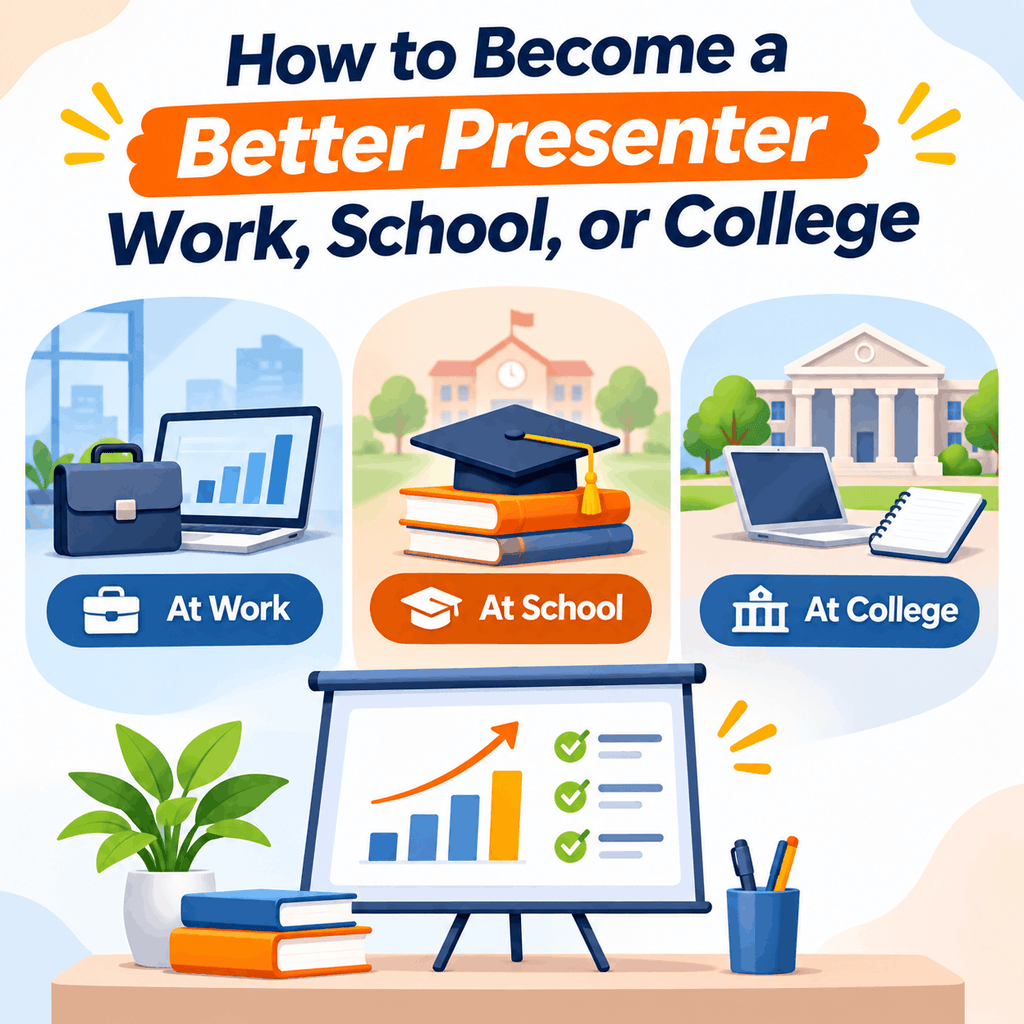
How to Become a Better Presenter at Work, School, or College
Presentation skills are useful in almost every stage of life. Whether you’re explaining a classroom project, sharing business ideas in a meeting, or delivering a professional pitch, the ability to communicate confidently can help you make a stronger impression.
However, the way you approach a presentation may differ depending on your audience and purpose. Here are some practical ways to become a better presenter in different situations.
1. How to Become a Better Presenter at Work
Workplace presentations often involve sharing business updates, explaining project progress, presenting strategies, or convincing stakeholders to support an idea. To present effectively at work, focus on delivering relevant information clearly and professionally.
- Start with the main objective of your presentation.
- Use charts, graphs, and infographics to explain business information.
- Keep your slides professional and avoid unnecessary details.
- Support your ideas with data, examples, and practical recommendations.
- Prepare for questions from managers, clients, or colleagues.
Pro tip: When presenting at work, focus on what your audience needs to know and how your information can help them make decisions.
2. How to Become a Better Presenter in School or College
Academic presentations give students an opportunity to explain what they’ve learned, demonstrate their knowledge, and develop communication skills. However, speaking in front of classmates and teachers can feel intimidating, especially for beginners.
Here are some ways to improve:
- Research your topic thoroughly before preparing your presentation.
- Organize your information into an introduction, main points, and conclusion.
- Use simple language and examples to explain difficult concepts.
- Include relevant images, diagrams, and visuals to support your ideas.
- Practice your presentation several times before presenting in class.
- Maintain eye contact with your classmates instead of reading directly from your notes.
Pro tip: Focus on understanding your topic rather than memorizing your entire speech. It will help you explain ideas more naturally and answer questions confidently.
3. How to Become a Better Presenter in Online Meetings
Virtual presentations require a slightly different approach because you’re communicating through a screen rather than standing in front of a physical audience. Background distractions, poor audio quality, and limited interaction can make it harder to keep people engaged.
To deliver better online presentations:
- Check your microphone, camera, internet connection, and screen-sharing settings beforehand.
- Choose a clean and distraction-free background.
- Position your camera at eye level and look toward it while speaking.
- Use clear, readable slides that are easy to follow on smaller screens.
- Encourage participation through questions, polls, and chat discussions.
- Keep your presentation focused and avoid unnecessarily long explanations.
Pro tip: Treat online presentations like face-to-face conversations. Speak naturally, interact with participants, and give your audience opportunities to share their thoughts.
Final Thoughts: Become a Better Presenter With Consistent Practice
Becoming a better presenter isn’t about delivering a perfect speech or creating the most attractive slides. It’s about communicating your ideas clearly, connecting with your audience, and making your message meaningful. From understanding your listeners and organizing your content to improving your body language and practicing regularly, every small improvement can make a difference.
Remember, great presenters aren’t born overnight. They develop their skills through preparation, experience, and continuous learning. So, the next time you prepare a presentation, put these tips into practice and look for opportunities to improve.
Need a presentation that looks as good as it sounds? Explore SlideChef’s collection of professionally designed PowerPoint and Google Slides templates to create visually appealing presentations that help you communicate your ideas with confidence.
About The Author




Related Blogs