Table of Contents
How to Develop a Growth Mindset: 15 Strategies to Improve Yourself
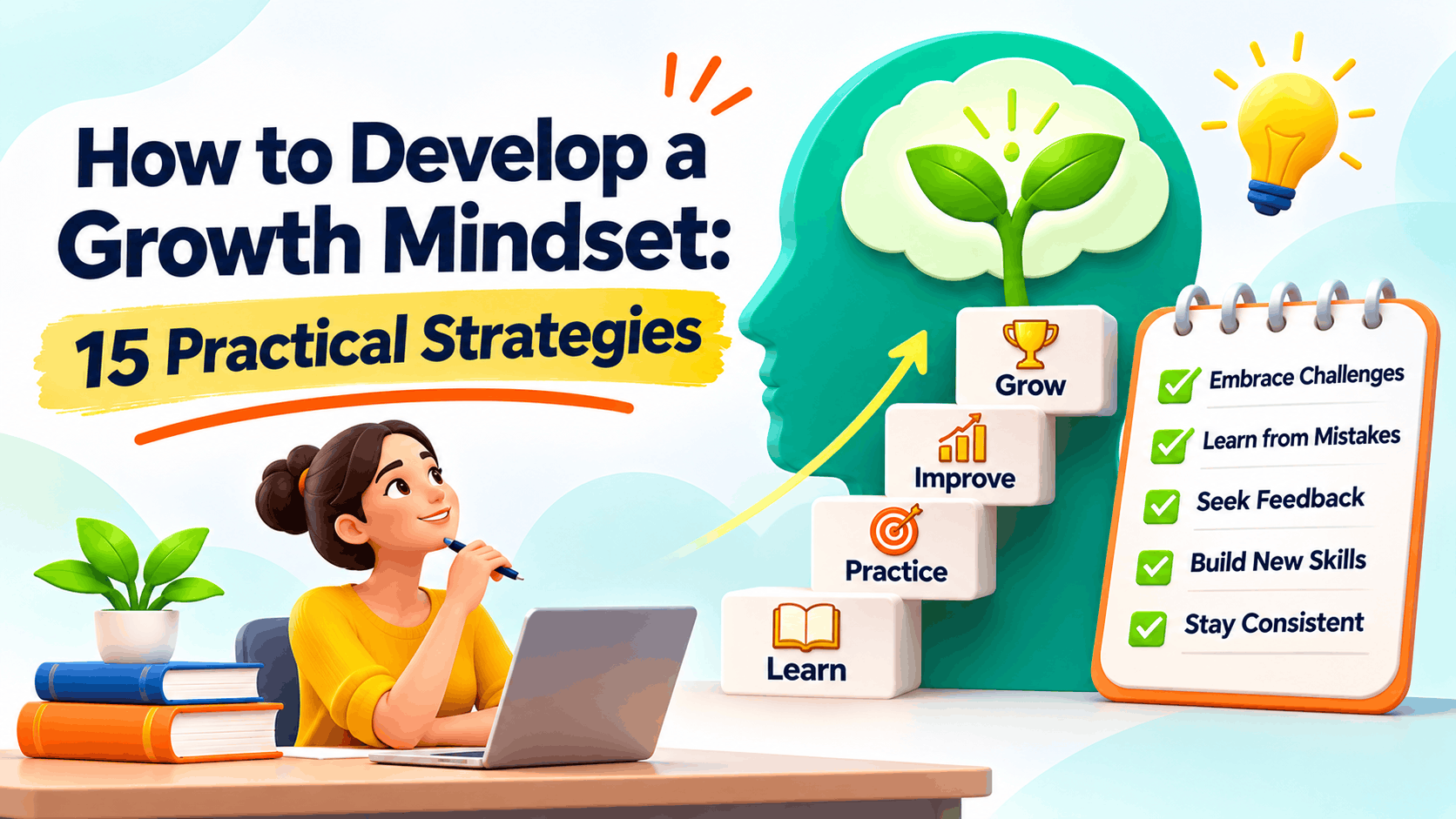
Have you ever avoided trying something new because you thought you weren’t good enough? Perhaps you gave up on a difficult task, felt discouraged by criticism, or compared your abilities with someone who seemed naturally talented. These situations often reflect a fixed mindset—the belief that your abilities cannot change significantly.
But what if you could approach challenges differently?
Developing a growth mindset means learning to see your abilities as skills that can improve through practice, effective strategies, feedback, and experience. Instead of treating mistakes as proof that you lack talent, you begin using them as opportunities to understand what needs to change.
Whether you are a student preparing for exams, a professional developing new skills, an entrepreneur building a business, or someone working toward personal goals, a growth mindset can help you approach learning with greater confidence and persistence.
In this guide, we’ll explore what a growth mindset means, how it differs from a fixed mindset, its benefits, and 15 practical strategies you can start using in everyday life.
Try using different techniques like, ‘‘Pomodoro Technique”, used by many industrialists and successful business tycoons for effective time management. We have a full guide on, ” How to use Pomodoro Technique to boost productivity.”
What Is a Growth Mindset?
A growth mindset is the belief that intelligence, abilities, and skills can develop over time through learning, practice, effective strategies, and dedication.
The concept was popularized by psychologist Carol Dweck through her research on motivation and achievement. It challenges the assumption that people are born with a fixed amount of intelligence or talent that determines what they can accomplish.
For example, imagine learning to create a presentation for the first time. You might struggle with organizing information, choosing suitable visuals, or explaining your ideas clearly.
A fixed mindset might make you think, “I’m just not creative enough to do this.”
A growth mindset encourages a different response: “I haven’t mastered presentation design yet, but I can improve by studying examples, practicing, and learning from feedback.”
The difference isn’t simply positive thinking. It is how you respond to difficulties and what actions you take to improve.
A growth mindset doesn’t mean that everyone has identical abilities or unlimited potential. It means recognizing that your current level of ability does not have to define your future level of ability.
Fixed Mindset vs. Growth Mindset: What’s the Difference?
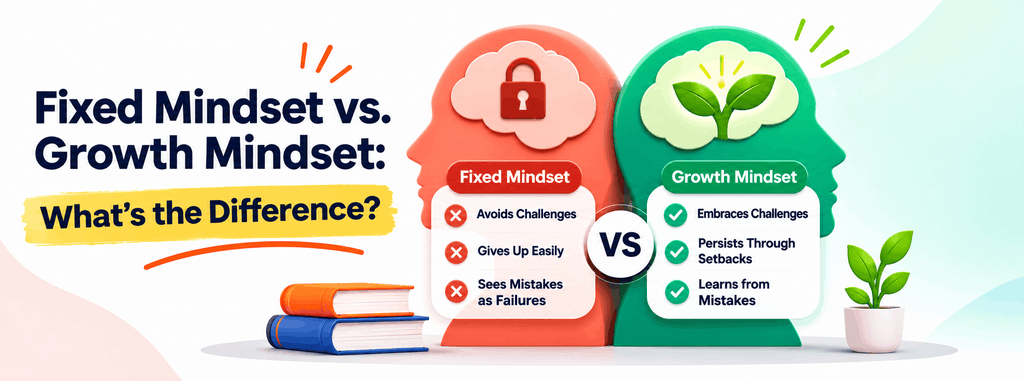
A fixed mindset and a growth mindset represent two different ways of thinking about personal abilities, learning, challenges, and failure.
People with a fixed mindset tend to believe that intelligence and talent are relatively unchangeable. They may avoid situations where mistakes could expose their weaknesses.
People with a growth mindset believe that abilities can be developed. They are generally more willing to experiment, seek feedback, and learn from setbacks.
Here is a comparison:
| Fixed Mindset | Growth Mindset |
|---|---|
| Believes abilities are mostly unchangeable | Believes abilities can be developed |
| Avoids difficult challenges | Approaches challenges as learning opportunities |
| Gives up when things become difficult | Looks for different ways to solve problems |
| Takes criticism personally | Uses constructive feedback to improve |
| Feels threatened by others’ success | Learns from other people’s achievements |
| Focuses mainly on proving ability | Focuses on developing ability |
| Sees mistakes as failures | Treats mistakes as useful information |
| Believes talent should make tasks easy | Understands that improvement requires practice |
Example: Imagine two employees receive feedback that their presentation skills need improvement.
The first employee feels embarrassed and concludes that public speaking isn’t their strength. They avoid future presentation opportunities.
The second employee asks which areas need improvement, practices speaking, studies effective presentation techniques, and requests feedback after their next presentation.
Both employees received the same feedback. However, their responses created different opportunities for improvement.
It’s also important to understand that people aren’t permanently divided into two categories. You might demonstrate a growth mindset when learning a new skill but experience fixed-mindset thinking when facing criticism or competition.
Recognizing these situations is the first step toward changing your response.
What Are the Benefits of Having a Growth Mindset?
Developing a growth mindset can influence how you approach education, work, relationships, and personal goals. It doesn’t guarantee success, but it can encourage behaviors that make learning and improvement more productive.
Here are some important benefits:
1. Builds Confidence in Your Abilities
When you believe your skills can improve, you’re less likely to let your current limitations define you. You become more comfortable attempting unfamiliar tasks and developing abilities that once seemed difficult.
2. Helps You Handle Failure
Instead of treating failure as a final judgment, you learn to examine what went wrong. This makes it easier to identify mistakes, adjust your approach, and try again with a better strategy.
3. Encourages Continuous Learning
A growth mindset creates curiosity. You become more willing to read, explore, ask questions, learn new technologies, and develop skills throughout your life.
4. Improves Problem-Solving Skills
When one approach doesn’t work, you become more open to alternatives. You may experiment with different methods, seek advice, or break a complicated problem into smaller tasks.
5. Makes Feedback More Valuable
Constructive criticism becomes an opportunity to discover areas that need attention rather than something to avoid. You can use other people’s observations to improve the quality of your work.
6. Supports Personal and Professional Development
Whether you want to improve communication, leadership, creativity, or technical abilities, a growth mindset encourages you to take practical steps toward development.
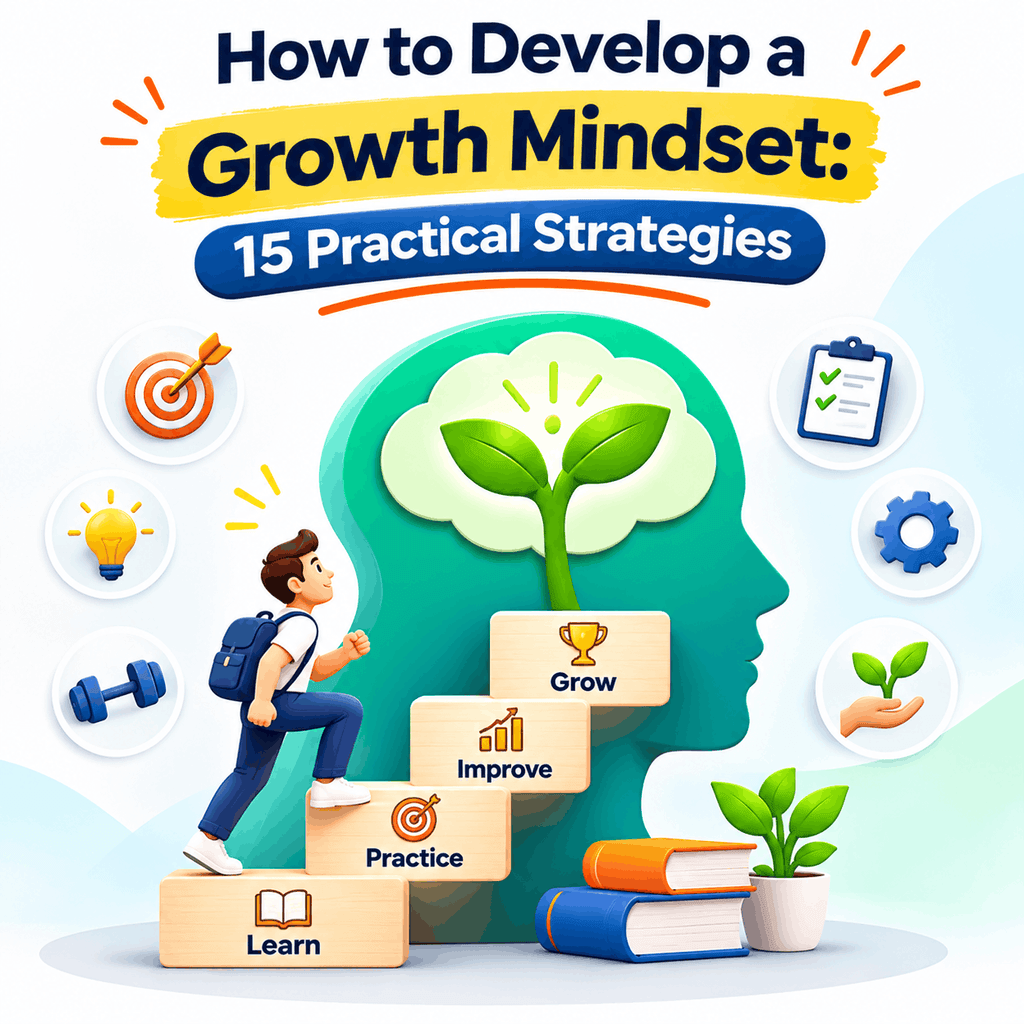
How to Develop a Growth Mindset: 15 Practical Strategies
Building a growth mindset is not an overnight transformation. It develops through small decisions, repeated actions, and the willingness to change how you respond to everyday situations.
Here are 15 strategies you can practice to cultivate a growth mindset.
1. Recognize Your Fixed Mindset Thoughts
The first step is identifying the thoughts that prevent you from trying something new.
Pay attention to statements such as:
- I’m not intelligent enough to understand this.
- I’m terrible at public speaking.
- I’ll never learn this skill.
- I’m not creative.
- I always fail at difficult tasks.
These thoughts often turn temporary difficulties into permanent limitations.
Instead of accepting them as facts, question where they come from. Are you struggling because you lack the ability, or because you haven’t learned the right approach yet?
Try this: Write down three negative thoughts you frequently have about your abilities. Next to each one, write a more constructive statement that focuses on learning and improvement.
2. Add the Word “Yet” to Your Vocabulary
One of the simplest ways to encourage growth-oriented thinking is to add the word “yet” to negative statements.
For example:
| Fixed Mindset Statement | Growth Mindset Statement |
|---|---|
| I can’t solve this problem. | I can’t solve this problem yet. |
| I’m not good at writing. | I’m still developing my writing skills. |
| I don’t understand this topic. | I haven’t understood this topic yet. |
| I can’t speak confidently. | I can improve my speaking confidence with practice. |
| I’m not a creative person. | I can develop my creative thinking skills. |
This small language change reminds you that your present ability is not necessarily your final ability.
However, simply adding “yet” isn’t enough. Follow it with an action that helps you make progress.
3. Embrace Challenges Instead of Avoiding Them
Challenges provide opportunities to discover what you can improve.
When you consistently choose tasks that are already easy, you may miss opportunities to develop new abilities.
For example, a student who struggles with mathematics could avoid difficult problems to protect their grades. However, working through appropriately challenging questions can help them identify gaps in their understanding.
The same principle applies at work. Volunteer for a project that requires learning a new tool, improving communication, or collaborating with unfamiliar colleagues.
Try this: Choose one task you’ve been avoiding and break it into smaller, manageable steps. Start with the easiest step and gradually increase the difficulty.
4. Learn to Accept Constructive Criticism
Feedback can reveal problems that you might not notice yourself. However, people with fixed-mindset thinking sometimes interpret criticism as a personal attack.
Instead, separate feedback about your work from judgments about your identity.
For example, if someone says your presentation contains too much text, don’t assume you are a poor designer. Consider how you can simplify the slides, improve visual hierarchy, and communicate information more clearly.
A useful feedback process includes:
- Listen without immediately defending yourself.
- Ask questions to understand the problem.
- Identify which suggestions are actionable.
- Decide what changes to make.
- Review the results after implementing them.
Remember, not every criticism is accurate or useful. Evaluate feedback thoughtfully rather than accepting everything without question.
5. Focus on Progress Rather Than Perfection
Perfectionism can prevent you from starting new projects because you worry about making mistakes.
A growth mindset encourages you to focus on improvement rather than expecting flawless results from the beginning.
For example, if you’re learning graphic design, your first few designs may not look professional. Instead of abandoning the skill, compare your latest work with your previous attempts and identify what has improved.
Try this: Keep a record of your progress. Save your first attempt at a task and compare it with your work after a few weeks of consistent practice.
6. Develop a Habit of Continuous Learning
Learning shouldn’t stop when you finish school or receive a degree. New knowledge and skills can help you adapt to changing professional and personal environments.
You can develop a continuous learning habit by:
- Reading books and educational articles.
- Taking online courses.
- Watching educational tutorials.
- Attending workshops and webinars.
- Learning from experienced professionals.
- Exploring subjects outside your usual interests.
You don’t need to spend several hours learning every day. Even 20–30 minutes of focused learning can help you make steady progress.
7. Learn from Other People’s Success
Comparing yourself with successful people can sometimes create feelings of inadequacy.
A growth mindset encourages you to look beyond their achievements and understand the process behind them.
For example, instead of thinking, “She is naturally good at public speaking,” ask yourself:
- How does she prepare for presentations?
- How does she organize her ideas?
- What communication techniques does she use?
- How does she handle difficult questions?
This turns comparison into an opportunity to learn.
Try this: Identify someone whose skills you admire. Study their approach and choose one practical technique you can apply to your own development.
8. Treat Mistakes as Learning Opportunities
Making mistakes is a normal part of learning something unfamiliar. The important thing is what you do after making one.
Instead of repeatedly thinking about what went wrong, examine the situation and identify what you can change.
Use these questions:
- What exactly went wrong?
- What caused the mistake?
- What did I learn from it?
- Which strategy should I try next time?
For example, if you receive a poor result in an examination, review the questions you answered incorrectly. You might discover that you need more practice, better time management, or a different study method.
Mistakes become useful when you turn them into specific improvements.
9. Set Realistic and Challenging Goals
Goals provide direction and make personal development easier to measure.
However, setting unrealistic goals can create frustration and make you lose motivation.
Use smaller milestones to work toward larger objectives.
For example, if you want to become a confident public speaker, your goals might include:
- Week 1: Practice speaking for two minutes every day.
- Week 2: Record yourself giving a short presentation.
- Week 3: Present an idea to a small group.
- Week 4: Deliver a five-minute presentation and request feedback.
This approach makes improvement measurable and gives you opportunities to recognize your progress.
10. Focus on Strategies, Not Just Effort
Working harder doesn’t always mean working better.
When you face a difficult task, consider whether your current approach is effective. Sometimes the best way to improve is to change your strategy rather than simply spend more time doing the same thing.
For example, if reading a textbook repeatedly isn’t helping you remember information, try active recall, practice questions, mind maps, or explaining the topic to someone else.
Ask yourself:
- Is my current approach working?
- What alternative method could I try?
- Where do I need additional guidance?
- How can I measure whether the new strategy is effective?
A growth mindset combines effort with thoughtful learning strategies.
11. Develop Better Time Management Habits
Consistent practice requires time and planning. Without a structured routine, important learning activities can easily be postponed.
Try organizing your day around specific priorities.
One useful method is the Pomodoro Technique, which divides work into focused intervals followed by short breaks.
For example:
- Choose one task you want to complete.
- Work on it with full concentration for 25 minutes.
- Take a five-minute break.
- Repeat the process.
- Take a longer break after four work sessions.
This technique can help you manage distractions and create dedicated time for learning.
Read our detailed guide on How to Use the Pomodoro Technique to Boost Productivity.
12. Step Outside Your Comfort Zone
Your comfort zone consists of activities and situations that feel familiar. While comfort is important, staying within familiar boundaries all the time can limit opportunities to develop new skills.
Start with manageable experiences that challenge you slightly.
For example:
- Speak up during a team meeting.
- Try a new creative activity.
- Learn an unfamiliar software tool.
- Attend a professional networking event.
- Volunteer to lead a small project.
You don’t need to make dramatic changes. Small experiences can gradually make unfamiliar situations feel more manageable.
13. Practice Positive and Constructive Self-Talk
The way you speak to yourself can influence how you respond to challenges.
Negative self-talk can make temporary setbacks feel permanent. Constructive self-talk helps you acknowledge difficulties while focusing on possible solutions.
Replace statements like these:
- “I’m going to fail” with “I’ll prepare and give it my best effort.”
- “I made a terrible mistake” with “I can learn from what happened.”
- “Everyone is better than me” with “I can learn from their experience.”
- “This is impossible” with “I need to find another approach.”
The goal isn’t to ignore your emotions or pretend everything is easy. It’s to respond to difficult situations with a more useful perspective.
14. Celebrate Small Achievements
Personal development involves many small improvements that may not immediately produce dramatic results.
Recognizing these achievements can help you stay motivated.
For example, celebrate when you:
- Complete a challenging assignment.
- Learn a new skill.
- Apply feedback successfully.
- Finish a project you previously avoided.
- Become more confident in a difficult situation.
You don’t have to wait until you achieve a major goal to recognize progress.
15. Build a Supportive Learning Environment
Your environment can influence how you approach challenges and learning.
Surround yourself with people who encourage curiosity, share knowledge, offer constructive feedback, and support your development.
You can also create a learning-friendly environment by:
- Keeping useful books and learning resources accessible.
- Joining communities related to your interests.
- Finding mentors who can guide your development.
- Setting aside dedicated time for learning.
- Reducing distractions during focused work.
Remember that asking for help isn’t a sign of weakness. It can be one of the most effective ways to overcome a learning challenge.
Growth Mindset Examples in Everyday Life
Understanding the concept becomes easier when you see how it works in real situations.
Here are five practical growth mindset examples:
Example 1: A Student Struggling with an Exam
Fixed mindset: “I’m not good at science. I’ll never understand this subject.”
Growth mindset: “I need to understand which concepts are difficult and spend more time practicing them.”
Action: Review incorrect answers, ask the teacher for guidance, and use practice questions to improve understanding.
Example 2: An Employee Receiving Negative Feedback
Fixed mindset: “My manager doesn’t think I’m capable of doing this job.”
Growth mindset: “The feedback shows me which parts of my work need improvement.”
Action: Discuss specific areas for development and create an improvement plan.
Example 3: An Entrepreneur Facing Business Challenges
Fixed mindset: “My business idea failed. I’m not meant to be an entrepreneur.”
Growth mindset: “The results didn’t match my expectations. I need to understand why and reconsider my approach.”
Action: Examine customer feedback, review business decisions, and test alternative strategies.
Example 4: Someone Learning a New Skill
Fixed mindset: “I’m too old to learn something new.”
Growth mindset: “Learning may take time, but I can improve through regular practice.”
Action: Start with beginner-friendly resources and set achievable learning milestones.
Example 5: A Person Trying to Improve Their Fitness
Fixed mindset: “I’ll never become fit because I’m not athletic.”
Growth mindset: “I can gradually improve my fitness by following an appropriate routine.”
Action: Set realistic goals, track progress, and adjust the routine as your fitness improves.
A Simple 7-Day Growth Mindset Challenge
If you want to put these strategies into practice, start with this seven-day challenge.
You don’t need to change your entire routine. Spend a little time each day practicing one growth-oriented behavior.
| Day | Activity | Your Goal |
|---|---|---|
| Day 1 | Identify fixed mindset thoughts | Recognize negative self-talk |
| Day 2 | Practice using “yet” | Reframe limiting beliefs |
| Day 3 | Try something challenging | Step outside your comfort zone |
| Day 4 | Ask for feedback | Identify an area for improvement |
| Day 5 | Learn a new skill | Spend 20–30 minutes learning |
| Day 6 | Reflect on a mistake | Identify one lesson from failure |
| Day 7 | Review your progress | Set your next development goal |
At the end of the week, ask yourself:
- What did I learn about my current mindset?
- Which challenge helped me the most?
- What negative thought did I successfully reframe?
- What do I want to improve next week?
Repeat the process and gradually turn these activities into regular habits.
Final Thoughts: Make Growth a Part of Your Everyday Life
Developing a growth mindset begins with changing how you respond to challenges, mistakes, and opportunities to learn. You don’t need to become an expert overnight or achieve every goal immediately. What matters is your willingness to recognize areas for improvement and take consistent steps toward them.
Start by questioning limiting beliefs, accepting constructive feedback, setting realistic goals, and learning from everyday experiences. Over time, these small actions can help you become a more adaptable and confident learner.
Remember, your current abilities represent where you are today, not necessarily where you can be tomorrow.
Want to make learning and personal development more engaging? Explore SlideChef’s collection of professionally designed PowerPoint templates and infographics to create presentations that communicate your ideas clearly and effectively.
How can I develop a growth mindset?
You can develop a growth mindset by recognizing limiting beliefs, accepting challenges, learning from mistakes, seeking constructive feedback, and focusing on continuous improvement. Start with small actions and practice them consistently.
What are the five characteristics of a growth mindset?
Five common characteristics include:
Willingness to embrace challenges.
Persistence when facing difficulties.
Openness to constructive feedback.
Curiosity and continuous learning.
Ability to learn from mistakes and setbacks.
These characteristics describe common growth-oriented behaviors rather than a fixed personality type.
What is an example of a growth mindset?
An example is a student who performs poorly on an examination but decides to review their mistakes, change their study strategy, seek help, and practice more. Instead of assuming they cannot succeed, they treat the experience as an opportunity to improve.
Can adults develop a growth mindset?
Yes. Adults can develop more growth-oriented thinking by recognizing limiting beliefs, learning new skills, seeking feedback, and practicing different approaches to challenges. Personal development can continue at any age.
About The Author




Related Blogs