What is the Main Purpose of Developing a Business Pitch? (Ultimate Guide)

How to Develop a Successful Pitch?
The main purpose of developing a business pitch is to clearly and concisely communicate your company’s value proposition to secure funding, attract strategic partners, or win new clients. Ultimately, the primary goal of a pitch is not to close a complex deal on the spot, but to generate enough targeted interest to secure a follow-up meeting and move into the due diligence phase.
Every day, brilliant business ideas fail not because the product is flawed, but because the founder could not explain its value fast enough. Whether you are stepping into a boardroom full of venture capitalists, networking at an industry event, or trying to land a massive enterprise client, your pitch is the bridge between your vision and their capital. A well-crafted pitch distills months of complex business planning into a digestible, high-impact narrative. Below, we break down exactly what a business pitch is, the core strategic purposes it serves, and how to structure a presentation that forces decision-makers to take action.
What is a Business Pitch? Definition and Examples
At its core, a business pitch is a structured presentation—delivered verbally, visually, or both—designed to persuade an external audience to support your company’s vision. It is the highly concentrated version of your comprehensive business plan, highlighting only the most critical data points: the problem you are solving, your target market, your revenue model, and your growth projections.
While a traditional business plan serves as a lengthy, internal operational roadmap, a pitch is a fast-paced, strategic marketing tool used to generate external momentum and secure buy-in from decision-makers.
Depending on your audience and the setting, this presentation can take several different forms. Here are the three most common types of business pitches:
1. The Elevator Pitch
This is a brief, 30-to-60-second verbal summary used primarily at networking events, trade shows, or unexpected encounters. The goal is not to secure funding on the spot, but to quickly establish your value proposition, spark curiosity, and exchange contact information for a formal follow-up.
2. The Investor Pitch Deck
This is a formal, 10-to-15-slide visual presentation used to raise venture capital, seed money, or angel funding. This format relies heavily on clean data visualization and a compelling narrative flow to prove to investors that your startup offers a scalable, high-return opportunity.
3. The Sales Pitch
A highly tailored presentation designed specifically to convert B2B prospects into paying enterprise clients. Unlike an investor pitch that focuses on company equity and market size, a sales pitch focuses strictly on how your product or service will directly solve the client’s operational pain points and improve their immediate bottom line.
Real-World Examples of Effective Business Pitches
Understanding the theory behind a pitch is only half the battle; seeing how these concepts play out in the real world is where the strategy truly clicks. Whether you are delivering a rapid-fire verbal introduction in a lobby or presenting a heavily researched visual slide deck in a boardroom, your tone, data, and delivery must adapt to the specific scenario. Here is a look at how different types of business pitches are successfully executed in action:
Sparkle StartUp Business Pitch Deck Template by SlideChef

The Startup Pitch Deck template by SlideChef delivers a crisp, modern aesthetic designed to project confidence and clarity in the boardroom. Featuring a clean white background paired with vibrant, gradient-blue text boxes and accents, it strikes an ideal balance between professional reliability and dynamic startup energy. The template offers highly structured, versatile slide layouts equipped with distinct image placeholders, circular cutouts, and grid sections, making it effortless to organize team profiles, showcase product imagery, and present complex business data without visually overwhelming your investors.
Dark Theme Business Pitch Deck Template
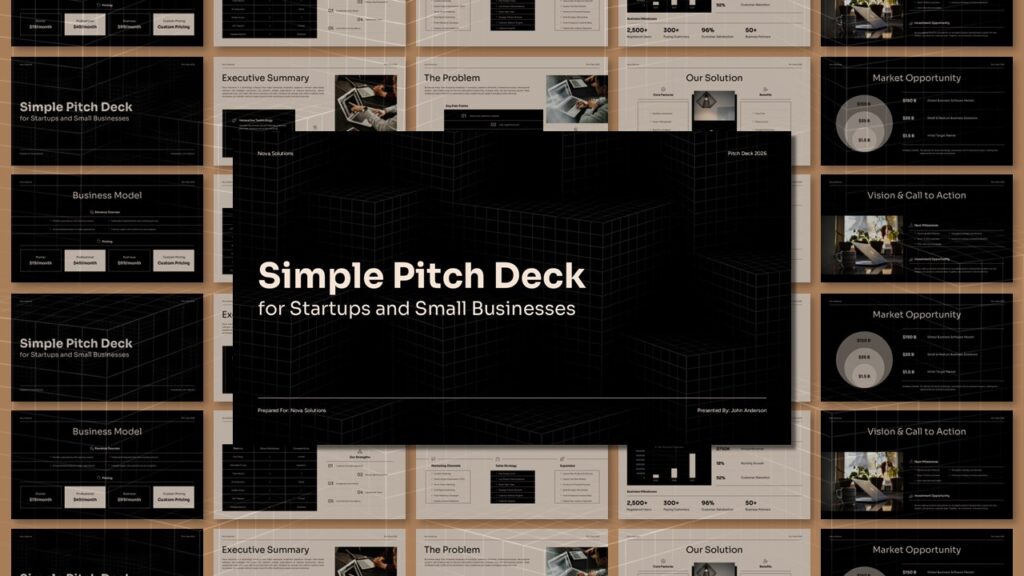
For founders looking to project a sophisticated and commanding presence, this Dark Theme Business Pitch Deck offers a sleek, minimalist aesthetic. Titled “Simple Pitch Deck for Startups and Small Businesses,” the design anchors itself with deep black backgrounds accented by subtle, geometric grid lines that add modern depth without distracting from the content. It strategically contrasts these dark layouts with muted beige slides to maintain visual interest throughout the presentation. Featuring highly structured, pre-built layouts for essential narrative beats—including the “Executive Summary,” “The Problem,” “Our Solution,” “Market Opportunity,” and “Business Model”—this template ensures your core data and value proposition take center stage in a highly professional, investor-ready format.
Company Investment Proposal Deck Template by SlideKit
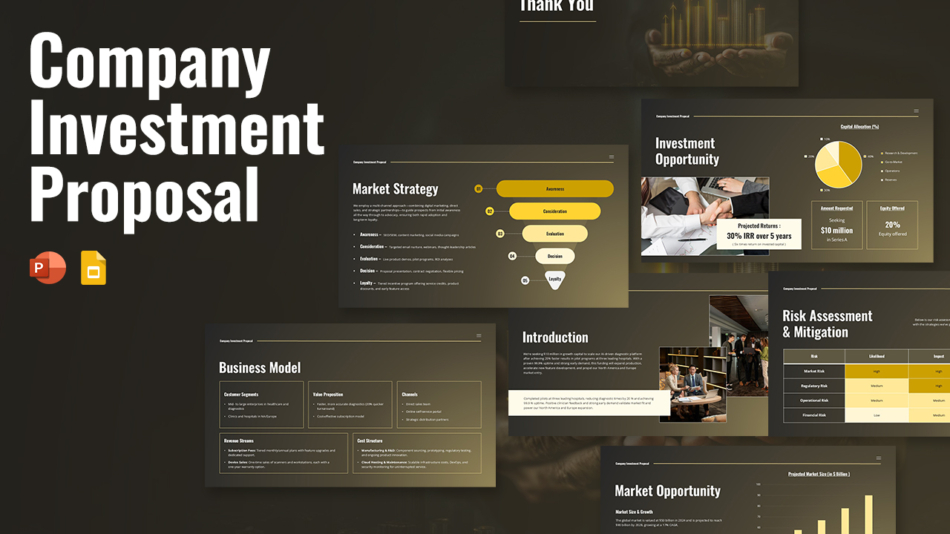
The Company Investment Proposal Deck by SlideKit utilizes a premium, high-contrast aesthetic, pairing a sophisticated dark background with striking gold and yellow accents. This color scheme instantly conveys a sense of executive authority and financial seriousness. Designed specifically for high-stakes funding rounds, the template is heavily data-driven, providing specialized layouts for critical investor metrics. Notable slides include a detailed “Investment Opportunity” breakdown highlighting capital allocation via a pie chart, a structured grid for mapping out the “Business Model,” a funnel diagram for “Market Strategy,” and a clear matrix for “Risk Assessment & Mitigation”. Compatible with both PowerPoint and Google Slides, it provides all the visual frameworks necessary to communicate complex financial propositions with absolute clarity.
Free Zomato Pitch Deck Template
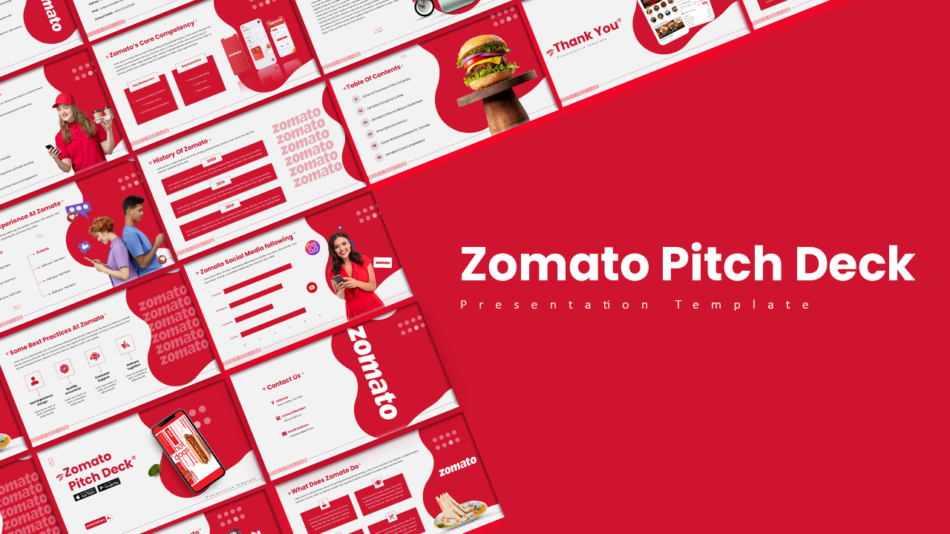
The Free Zomato Pitch Deck Template offers a vibrant, highly branded design dominated by a bold red and white color scheme. This presentation layout utilizes modern, curved graphic shapes alongside integrated imagery of food and mobile interfaces. It comes equipped with specific, pre-built slide structures tailored for a comprehensive company narrative, including dedicated sections for “Zomato’s Core Competency,” “History Of Zomato,” “Zomato Social Media following,” and operational best practices. This deck serves as an excellent visual case study for food-tech startups or delivery services looking to maintain a strong, consistent brand identity while communicating their business model.
Crowdfunding Pitch Deck Template by SlideBazaar
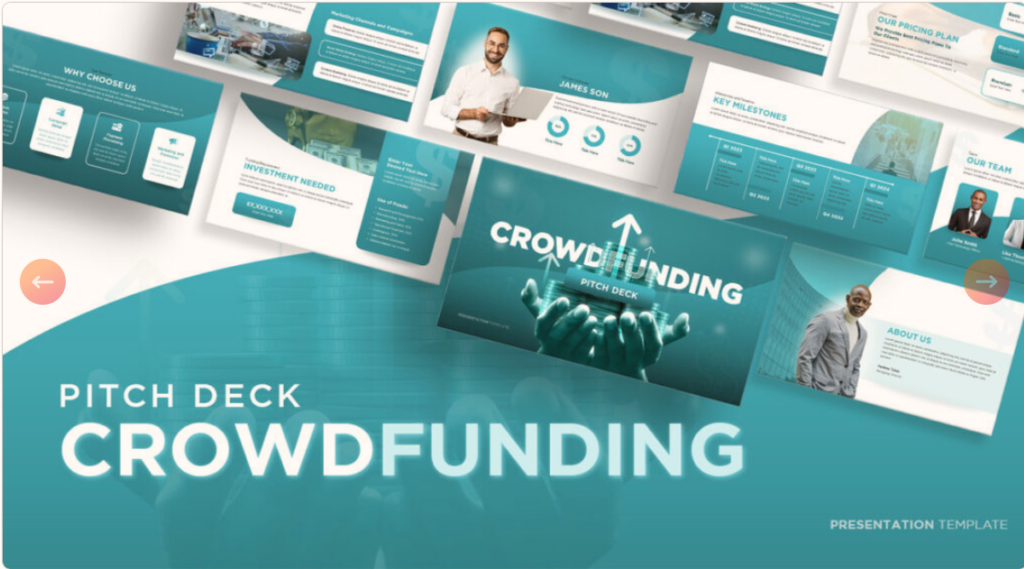
The Crowdfunding Pitch Deck Template by SlideBazaar utilizes a refreshing teal and white color palette, characterized by smooth, flowing wave graphics that create a modern and approachable aesthetic. The title slide instantly establishes its financial focus with a striking visual of hands supporting a growing stack of coins beneath an upward-pointing arrow. Built specifically to attract community backers and retail investors, this template features highly functional layouts including a clear “Investment Needed” breakdown, a horizontal timeline for tracking “Key Milestones,” and a structured “Our Pricing Plan” comparison. With dedicated sections for outlining “Why Choose Us” and clean profile cards for “Our Team,” it provides a cohesive, trust-building framework essential for driving successful crowdfunding campaigns.
Free Modern Pitch Deck Template by SlideBazaar
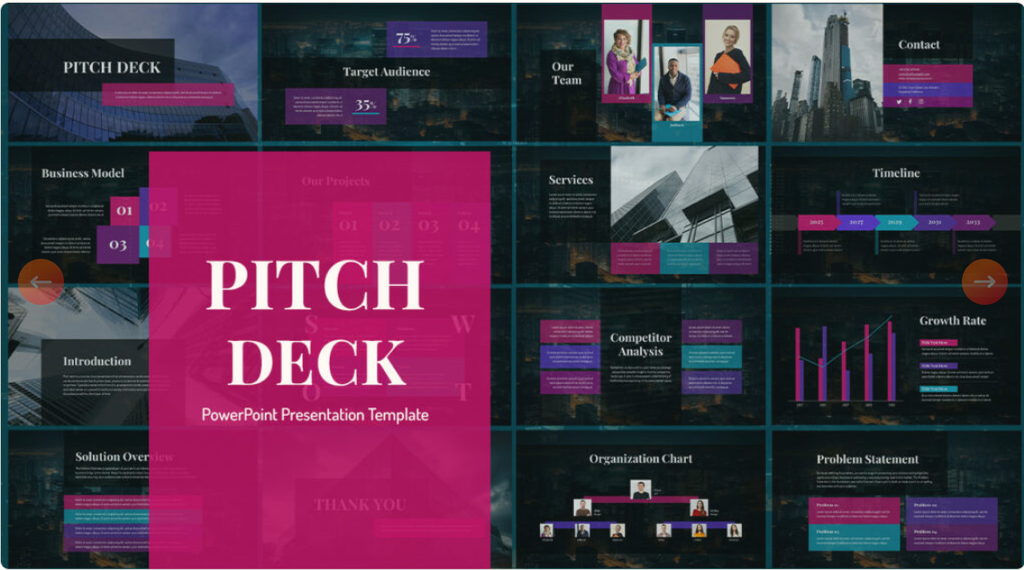
The Modern Pitch Deck Template features a bold, high-contrast design, utilizing a dark background overlaid with striking magenta and deep purple accents. It incorporates faded urban cityscape photography into the slide backgrounds, giving the presentation a sophisticated, metropolitan aesthetic. This template is highly versatile and ideal for startups or agencies needing to present a data-rich narrative, providing structured layouts for essential business beats like the “Problem Statement,” “Competitor Analysis,” and “Business Model”. To help easily visualize company progress and internal structure, the deck also comes equipped with a chevron-style “Timeline,” a clear “Growth Rate” chart, and a hierarchical “Organization Chart”.
The 4 Primary Purposes of Developing a Business Pitch
While the ultimate goal of any pitch is to generate external support, that support takes different forms depending on the stage and immediate needs of your company. Developing a highly focused business pitch generally serves four core strategic purposes:
1. Securing Capital and Investment
When most founders think of a business pitch, they immediately think of raising capital. Venture capitalists, angel investors, and bank loan officers review hundreds, sometimes thousands, of investment opportunities every year. A well-designed investor pitch deck is critical because it distills a massive, 50-page business plan into a digestible 10-minute narrative. Its primary purpose here is to clearly prove the financial viability of your company, demonstrate the total addressable market, and convince investors that their capital will yield a high return on investment (ROI).
2. Attracting Strategic Partnerships and Co-Founders
Money is not the only resource a growing business needs. A compelling business pitch is frequently used to secure high-level human capital and operational alliances. Startups use pitches to convince industry-leading executives to join their board, persuade technical co-founders to help build the product, or negotiate favorable terms with manufacturers and distributors. In these scenarios, the purpose of the pitch is to build immense trust and prove that aligning with your brand is a mutually beneficial, low-risk career or business move.
3. Validating the Business Model
One of the most overlooked purposes of a business pitch is internal clarity. The actual process of developing the presentation acts as a stress test for your startup. By forcing yourself to condense your revenue model, competitive advantages, and customer acquisition strategies into a few short slides, you quickly identify the logical holes in your own business plan. It forces founders to refine their value proposition and clarify their target audience before they ever present it to the open market.
4. Winning Enterprise B2B Clients
A business pitch is not strictly for investors; it is a highly effective tool for enterprise sales. When pitching a B2B product or service to corporate decision-makers, the presentation shifts from focusing on company equity to focusing on operational solutions. The purpose of a sales pitch is to demonstrate exactly how your product will solve the client’s specific pain points, streamline their workflow, and improve their immediate bottom line.
Core Components Every Winning Pitch Must Include
A successful business pitch is not a comprehensive operational manual; it is a carefully curated highlight reel. While the exact length and format will vary depending on whether you are at a networking event or in a formal boardroom, every effective presentation must hit five critical narrative beats to keep decision-makers engaged and drive them toward a “yes.”
The Problem (The Pain Point)
Start by defining the exact pain point your target audience currently experiences. Investors and clients do not fund products; they fund solutions to urgent, expensive problems. Quantify the problem with hard data to establish the stakes early and make the audience feel the friction in the current market.
The Solution (Your Value Proposition)
Introduce your product or service as the direct, elegant answer to the problem you just established. Keep this section simple and avoid dense technical jargon. Clearly explain how your solution works, the immediate benefits it provides, and why it is vastly superior to existing alternatives or competitors.
Market Size (Total Addressable Market)
Decision-makers need to know the ceiling of your potential success. Use realistic data to define your Total Addressable Market (TAM), Serviceable Available Market (SAM), and Serviceable Obtainable Market (SOM). A brilliant solution in a microscopic market will struggle to secure venture capital, so you must prove there is enough demand to support aggressive growth.
Traction (Proof of Concept)
Ideas are cheap; execution is valuable. Provide empirical evidence that the market actually wants what you are building. Highlight early revenue metrics, active user growth, customer acquisition costs (CAC), signed letters of intent, or strategic partnerships. Traction proves that your business model works in the real world, significantly lowering the risk for potential investors.
The “Ask” (Resource Requirements)
Never conclude a presentation without making a clear, highly specific request. State exactly how much capital you are raising (or what size contract you are proposing), what percentage of equity you are offering in return, and precisely how those funds will be allocated to achieve your next major growth milestone.
How Design Impacts the Success of Your Pitch
Investors and enterprise clients naturally equate the visual quality of your presentation with the operational quality of your business. A cluttered, disorganized pitch deck subconsciously signals messy internal management, whereas a clean, modern aesthetic instantly establishes executive authority and builds trust.
Strategic design uses clear visual hierarchies and focused data visualization to keep decision-makers locked on your core metrics—rather than forcing them to decipher chaotic slides.
However, your time is best spent refining your business model and practicing your delivery, not wrestling with slide margins and font alignments. By leveraging SlideChef’s premium, ready-to-use Pitch Deck templates, you bypass the tedious design phase entirely. These templates provide an instantly professional, executive-ready layout, allowing you to simply drop in your data and step into any boardroom with absolute confidence.
What is the main goal of an elevator pitch?
The main goal of an elevator pitch is to spark curiosity and clearly communicate your value proposition in under 60 seconds. It is designed to secure a follow-up meeting and exchange contact information, not to close a complex funding deal on the spot.
Who is the target audience for a business pitch?
The target audience varies depending on the context of the presentation. It typically includes venture capitalists or angel investors during funding rounds, prospective enterprise clients during B2B sales, or potential co-founders when building a strategic team.
How many slides should a business pitch have?
A standard investor pitch deck should contain 10 to 15 slides. The presentation should focus strictly on high-level data, market size, and the core value proposition rather than overwhelming the audience with granular, text-heavy operational details.
About The Author





Related Blogs