Table of Contents
- How to Create a Sales Presentation? Best Practices to Make a Sales Pitch Winning
- What is a Sales Presentation?
- Perfect Pitch Deck Examples
- The Anatomy of a Winning Sales Deck
- How to Build a Perfect Sales Presentation
- Pitch Deck Examples
- 6 Perfect Sales Presentation Deck Types
- Common Sales Presentation Mistakes to Avoid
- Conclusion: Master Your Sales Presentations to Close More Deals
What is a Sales Presentation? How to Create a Perfect Sales Pitch?

How to Create a Sales Presentation? Best Practices to Make a Sales Pitch Winning
Closing deals is harder than ever in today’s crowded market. Buyers are constantly distracted and tired of long, boring pitches. A strong sales presentation cuts through the noise to guide your prospects. It combines smart strategy with a clear, engaging conversation. Your main goal is to make every potential customer feel truly confident. Let us explore how you can build a winning deck from scratch.
This comprehensive guide on ”What is a Sales Presentation?” breaks down everything you need to know about crafting an effective sales deck. You will learn the core definition, explore real-world examples, and master proven steps to close more deals. Dive in to transform your pitching strategy and win over your buyers with absolute confidence.
What is a Sales Presentation?
A sales presentation is a structured visual pitch used to introduce a product or service to prospective buyers. Its core purpose is to bridge the gap between initial interest and a closed deal by clearly communicating value. Instead of just listing features, a strong presentation explains how your solution directly resolves the customer’s specific pain points and answers their most pressing questions. Sales teams rely on these strategic decks during face-to-face meetings, online webinars, and live product demos to keep conversations focused, organized, and deeply persuasive. By combining compelling data, clear messaging, and professional layouts, a well-crafted sales presentation transforms a hesitant prospect into a confident, paying customer ready to commit.
Perfect Pitch Deck Examples
Sales presentations come in many different formats depending on your industry, your target audience, and the specific stage of the buying journey. Every unique deal requires a tailored approach to effectively communicate your core value and address buyer concerns. By adapting your visual deck to match the context of the conversation, you can keep your prospects engaged from the opening slide to the final close.
1. Sales Speaker – Sales Deck Template by SlideChef

The Sales Speaker template from SlideChef is a sleek, professional deck built with a striking dark and red aesthetic. It features structured layouts for your sales growth metrics, strategy frameworks, process timelines, and communication strategies. This template helps sales teams pitch complex ideas clearly and keep prospective clients visually engaged from start to finish.
2. Annual Sales Meeting Presentation Template

The Annual Sales Meeting template from SlideChef is designed with a bold red-and-black layout built for team reviews and strategic planning. It includes pre-built slides for meeting agendas, performance overviews, regional performance charts, challenges and missed opportunities, and targets and action plans for the next year. This template helps you organize yearly data and align your team with absolute clarity.
3. Annual Sales Review Deck Template by SketchBubble
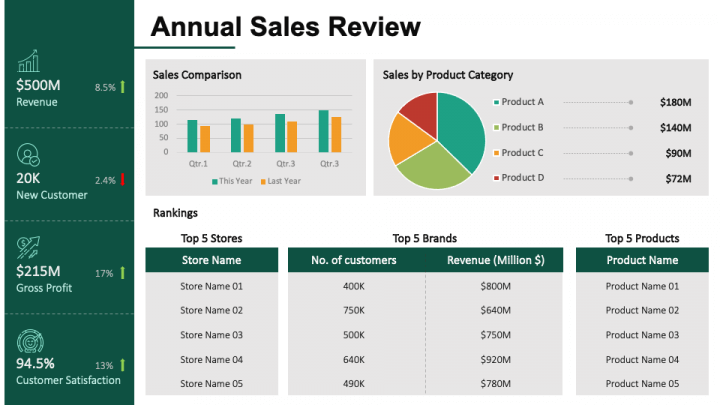
The Annual Sales Review template by Sketchbubble is structured with a professional green-and-grey dashboard layout. It features key metric callouts for revenue, new customers, gross profit, and customer satisfaction percentages. The layout includes built-in visual aids like quarterly sales comparison bar charts, product category pie charts, and structured ranking tables for top stores, brands, and products. This template helps you present heavy annual performance data cleanly and clearly.
4. Yearly Sales Plan Template by SlidesCarnival
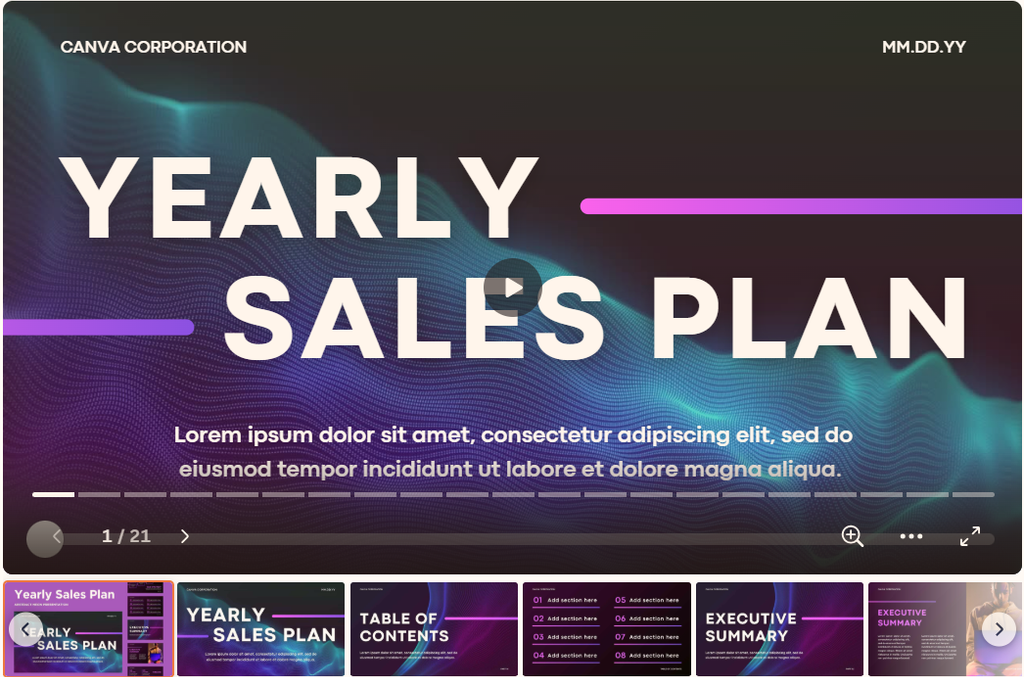
The Yearly Sales Plan template from SlidesCarnival features a modern, futuristic dark theme with glowing neon-blue and purple wave graphics. It is built for laying out your annual business strategy, executive summaries, tables of contents, and phased action plans. This template gives your sales strategy a high-impact, professional visual edge.
5. Used Vehicle Sales Plan Template by SlideKit
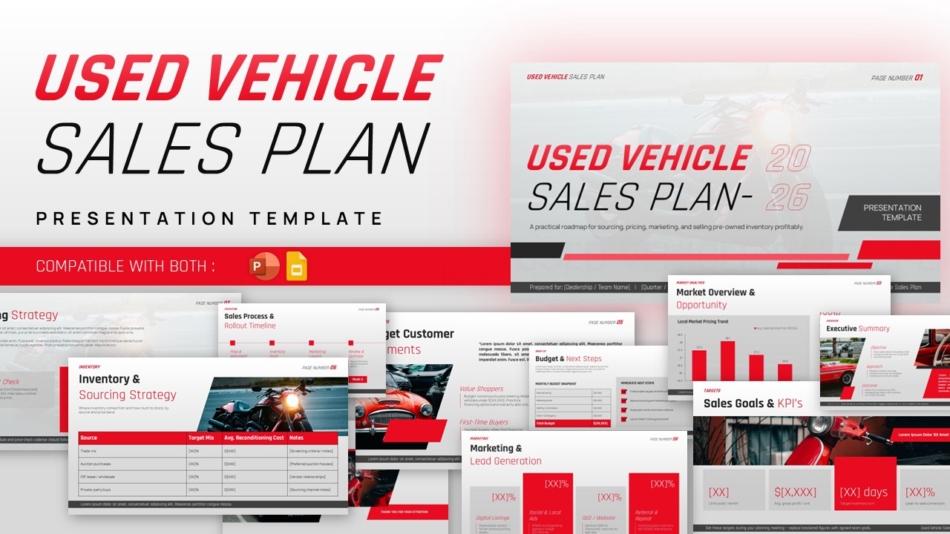
The Used Vehicle Sales Plan template by Slidekit features a clean, high-contrast red-and-white aesthetic built specifically for pre-owned automotive inventory strategies. It includes structured layouts for executive summaries, market overviews, sales goals and KPIs, inventory sourcing tables, target customer segments, roll-out timelines, and marketing lead generation splits. This template gives dealership teams a professional roadmap to price, market, and sell pre-owned vehicles profitably.
6. Colorful Theme Sales Presentation Template by SlideKit
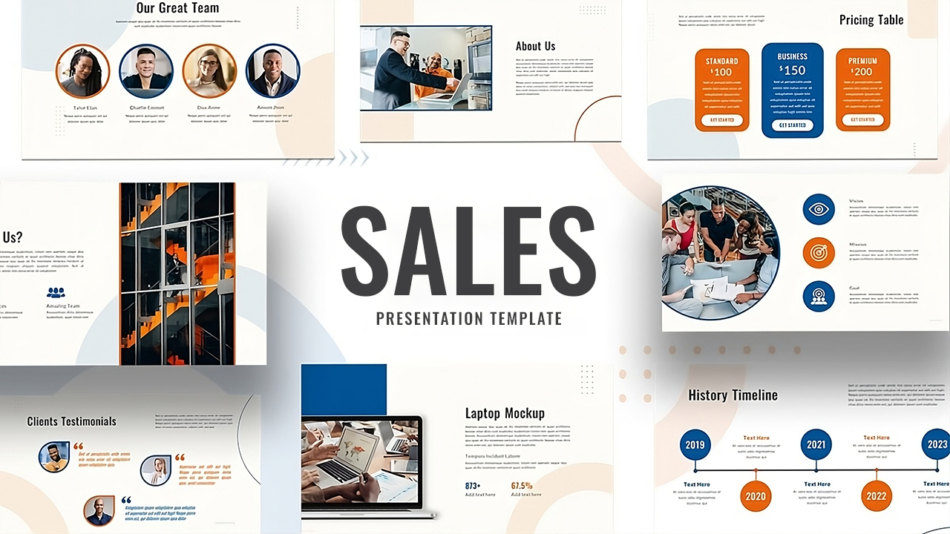
The Colorful Theme Sales Presentation template by Slidekit features a clean, vibrant aesthetic designed to make your business pitches pop. It includes structured layouts for team introductions, “About Us” sections, pricing tables, client testimonials, laptop mockups, and chronological history timelines. This template helps you showcase your company’s personality and offerings with engaging visual clarity.
The Anatomy of a Winning Sales Deck
Every great sales presentation follows a tested structure, and you should never just throw random facts together. A logical, well-planned flow is essential because it keeps your buyer interested from the very first slide to the final close. Below is a detailed breakdown of the core elements that form the architecture of a high-converting sales deck:
- The Hook: Grab attention in the very first minute by starting with a striking statistic, a relatable industry challenge, or a bold statement that immediately resonates with your audience.
- The Pain Point: Show that you deeply understand their exact struggles by articulating the daily frustrations and operational bottlenecks they are currently facing.
- The Solution: Introduce your product or service as the ultimate hero that effortlessly bridges the gap between their current frustration and a successful outcome.
- The Proof: Share hard data, case studies, client reviews, or performance metrics to build instant trust and validate your claims with undeniable evidence.
- The Close: Tell them clearly and directly what action to take next, removing all guesswork and guiding them smoothly toward booking a call or signing the contract.
How to Build a Perfect Sales Presentation
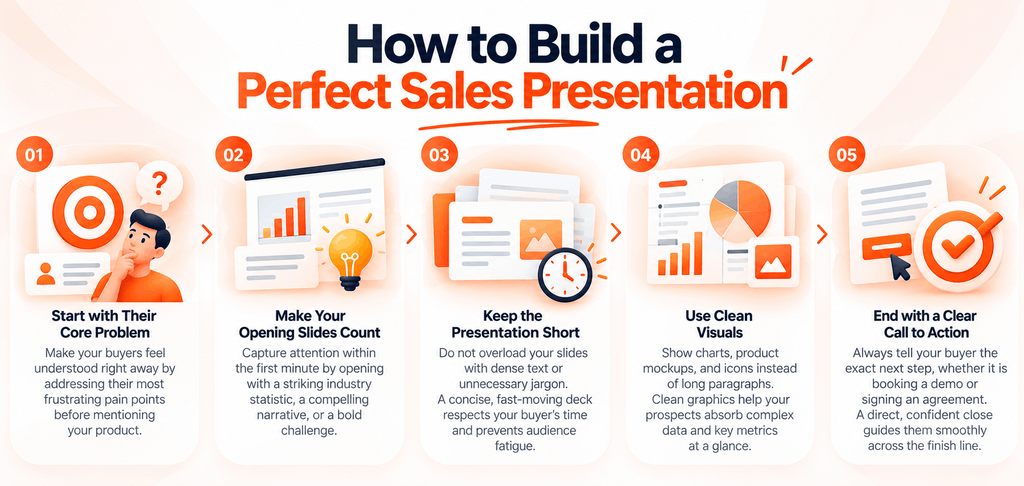
Building a good sales deck takes clear, deliberate steps, and you should never rush this important process. Crafting a high-converting presentation requires balancing strategy, brevity, and visual appeal to ensure your message lands effectively. Follow these simple rules to keep buyers hooked from start to finish:
- Start with their core problem: Make your buyers feel understood right away by addressing their most frustrating pain points before ever mentioning your product. When prospects realize you genuinely grasp their daily operational bottlenecks, their defenses drop and they become receptive to your pitch.
- Make your opening slides count: Capture attention within the first minute by opening with a striking industry statistic, a compelling narrative, or a bold challenge. The initial few slides set the emotional and strategic tone for the entire meeting, making a strong first impression non-negotiable.
- Keep the presentation short: Do not overload your slides with dense blocks of text or unnecessary corporate jargon that dilutes your core message. A concise, fast-moving deck respects your buyer’s limited time and prevents audience fatigue from setting in halfway through.
- Use clean visuals: Show charts, product mockups, and icons instead of long, tedious paragraphs to present information. Clean graphics allow your prospects to absorb complex data points and key metrics at a glance, keeping the meeting dynamic and conversational.
- End with a clear call to action: Always tell your buyer the exact next step required to move forward, whether it is booking a technical demo or signing an agreement. Leaving the conclusion ambiguous kills momentum, whereas a direct, confident close guides them smoothly across the finish line.
Pitch Deck Examples
A pitch deck is a specialized form of a sales presentation primarily used to secure funding, partnerships, or high-level buy-in. Startups and established teams alike rely on specific pitch formats to capture attention fast and communicate value under high-stakes pressure. Here are the notable examples of pitch decks you can use to structure your narrative:
- The Problem-Solution Deck: Focuses heavily on a glaring market gap and your unique fix. This format dives straight into the friction your target audience experiences, proving that the problem is urgent before positioning your product as the undeniable remedy.
- The Traction Deck: Highlights rapid growth, soaring revenue, and impressive user numbers right out of the gate. By leading with hard data and undeniable momentum, this deck reassures investors and stakeholders that your business model is already working in the real world.
- The Vision Deck: Inspires long-term belief in a disruptive, category-defining idea. Instead of relying on current quarterly metrics, this deck paints a bold picture of the future, showing how your innovation will completely reshape the industry over the next decade.
6 Perfect Sales Presentation Deck Types
You need different decks for different buying stages because a one-size-fits-all approach rarely closes high-value deals. Using the right format changes everything by matching your message to what the prospect actually cares about at that precise moment. Here are six types of presentation decks you should use to cover every stage of the sales journey:
- 1. The Classic Pitch Deck: Great for introducing your core business idea, value proposition, and market opportunity to new prospects or investors. This high-level deck sets the stage by explaining who you are, what problem you solve, and why your solution matters.
- 2. The Company Overview Deck: Perfect for sharing your brand history, company culture, and team credentials when building foundational corporate trust. It reassures potential partners that they are working with an established, reliable organization backed by real experts.
- 3. The Case Study Deck: Shows real proof from happy past clients to eliminate skepticism and validate your claims. By highlighting genuine success stories, testimonials, and measurable outcomes, this deck lets your past wins do the heavy lifting.
- 4. The Product Demo Deck: Walks buyers through your software features, workflows, and core functionalities step by step. Instead of speaking abstractly, this visual deck gives prospects a clear look at how your tool operates in real-time.
- 5. The Pricing & ROI Deck: Breaks down costs, packaging tiers, and financial returns clearly so decision-makers can justify the purchase. It cuts through the confusion by directly answering the buyer’s ultimate question: “What is my return on investment?”
- 6. The Interactive Deck: Keeps buyers engaged with clickable elements, non-linear navigation, and embedded media tailored to live conversations. This dynamic format allows you to adapt on the fly, jumping straight to the slides your prospect cares about most without breaking momentum.
Common Sales Presentation Mistakes to Avoid
Even experienced sales reps can fall into common traps that instantly kill momentum and lose deals. To keep your prospects engaged and moving toward a signed contract, you must actively avoid these six critical mistakes:
- Talking too much about yourself: Focus on the buyer, not just your company or your product’s long history. Prospects do not care about how great you think you are; they care about how you can solve their specific problems. Shift the spotlight entirely onto their pain points and desired outcomes.
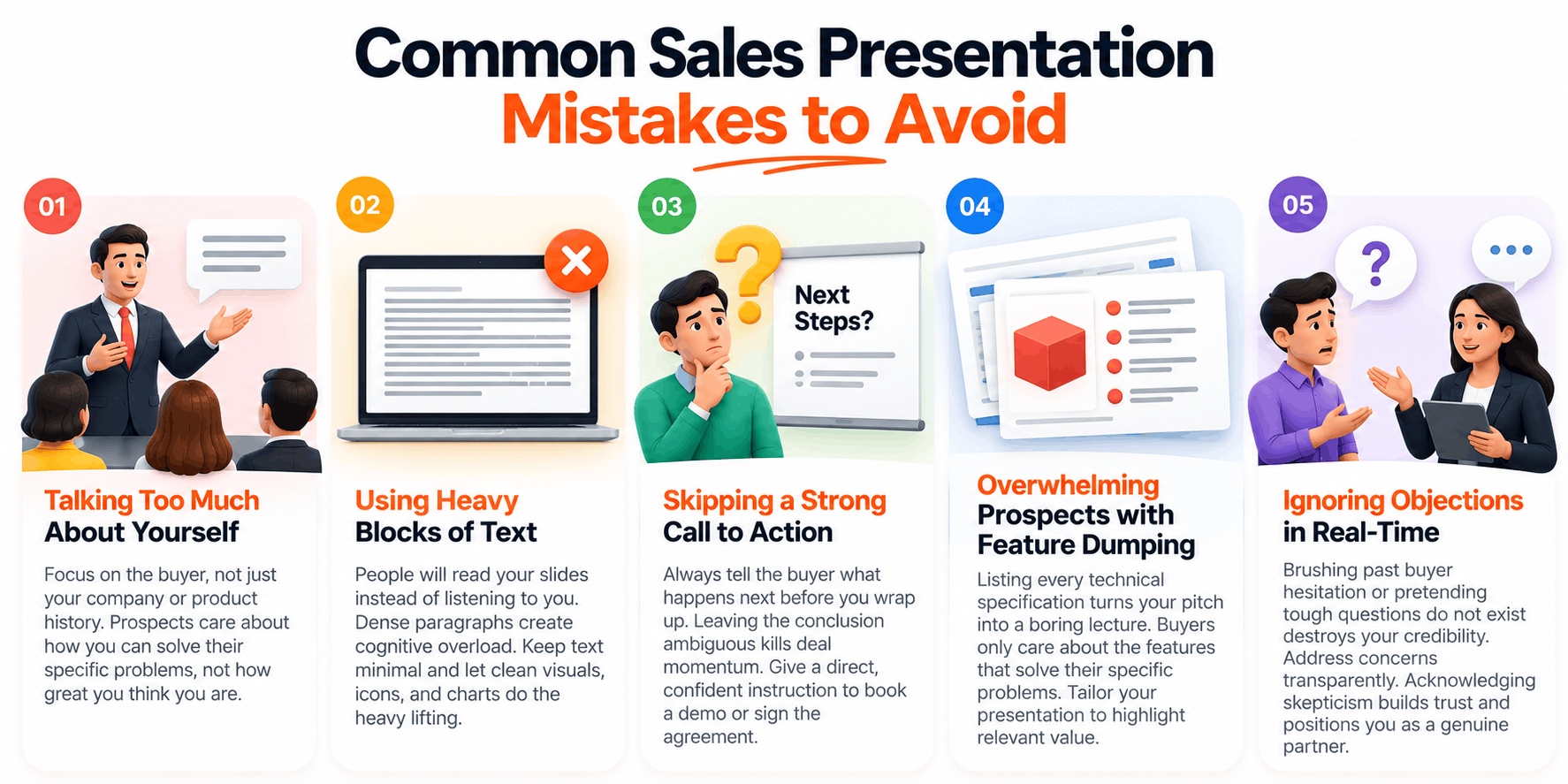
- Using heavy blocks of text: People will read your slides instead of listening to what you are actually saying. Dense paragraphs create cognitive overload and distract your audience. Keep text minimal and let clean visuals, icons, and charts do the heavy lifting.
- Skipping a strong call to action: Always tell the buyer what happens next before you wrap up the meeting. Leaving the conclusion ambiguous kills deal momentum and forces the prospect to guess their next step. Give them a direct, confident instruction to book a demo or sign the agreement.
- Overwhelming prospects with feature dumping: Listing every single technical specification instead of highlighting relevant value turns a sales pitch into a boring lecture. Buyers only care about the specific features that directly alleviate their daily frustrations. Tailor your presentation to address only what matters to that particular decision-maker.
- Ignoring objections in real-time: Brushing past buyer hesitation or pretending tough questions do not exist destroys your credibility. If a prospect raises a concern about pricing or implementation, address it head-on with transparency. Acknowledging skepticism builds trust and positions you as a genuine partner rather than a pushy salesperson.
- Failing to customize the pitch: Delivering a generic, one-size-fits-all presentation makes your prospect feel like just another number on a spreadsheet. If you do not adapt your deck to reflect their unique industry, team size, or workflow, they will assume you do not understand their business. Personalization is what separates amateur pitches from winning sales decks.
Conclusion: Master Your Sales Presentations to Close More Deals
A great sales presentation does more than just display features—it tells a compelling story that addresses your buyer’s deepest challenges and guides them smoothly toward a confident decision. By combining clean visuals, structured storytelling, and tailored formats, you can transform standard pitches into high-converting opportunities. Remember to keep your slides concise, focus entirely on the prospect’s needs, and always wrap up with a clear, decisive call to action. With the right presentation deck in hand, you will build instant trust, eliminate hesitation, and consistently close more deals.
What is the main goal of a sales presentation?
The main goal of a sales presentation is to guide a prospective buyer from initial curiosity to a confident purchasing decision by clearly communicating your core value and addressing their specific pain points.
How many slides should a standard sales deck have?
A high-converting sales deck typically ranges between 10 to 15 slides. Keeping it concise ensures you respect your buyer’s time and avoid cognitive overload.
What should be included on the first slide of a sales presentation?
Your opening slide should feature a clean, professional title, your company name, and a compelling hook or subtitle that immediately establishes what value you bring to the table.
How do I customize a sales deck for different clients?
You can tailor your deck by swapping out industry-specific case studies, adjusting your metrics to match their company size, and focusing heavily on the specific pain points that matter most to that unique decision-maker.
Why is a call to action crucial at the end of a sales deck?
A clear call to action removes all ambiguity and tells your prospect exactly what step to take next, preventing deal momentum from dying as soon as the meeting ends.
About The Author





Related Blogs