What is the Purpose of Brainstorming During Action Plan Development?

The primary purpose of brainstorming during action plan development is to bridge the gap between a high-level goal and a concrete execution strategy. It allows teams to clarify objectives, anticipate potential risks, generate diverse solutions, and foster collective ownership before any time or resources are committed to the project.
An action plan without a dedicated brainstorming phase is essentially just a blind guess. While it might feel productive to immediately start assigning tasks, jumping straight to execution often leads to missed opportunities and costly roadblocks. Brainstorming is the crucial “messy” phase where ideas are debated, refined, and tested. It ensures that the final, organized action plan is actually built on the strongest, most realistic foundation possible, saving your team countless hours in the long run.
Why You Can’t Skip Brainstorming in Strategic Planning
In fast-paced business environments, there is often an overwhelming pressure to “just start doing.” This leads many corporate teams to skip the brainstorming phase entirely, viewing it as an unnecessary delay in the action planning process. However, this is a dangerous misconception.
Pivoting your strategy during a whiteboard session costs absolutely nothing. Pivoting three weeks into project execution, after contracts are signed and hours are logged, costs thousands of dollars and ruins team morale. Brainstorming acts as your ultimate upfront risk management tool. It forces a pause, requiring project managers and stakeholders to critically evaluate the path forward before committing resources. By taking the time to explore all possible angles, you protect your action plan from fatal flaws that would otherwise derail the project mid-way through execution.
The 5 Core Purposes of Brainstorming in Action Planning
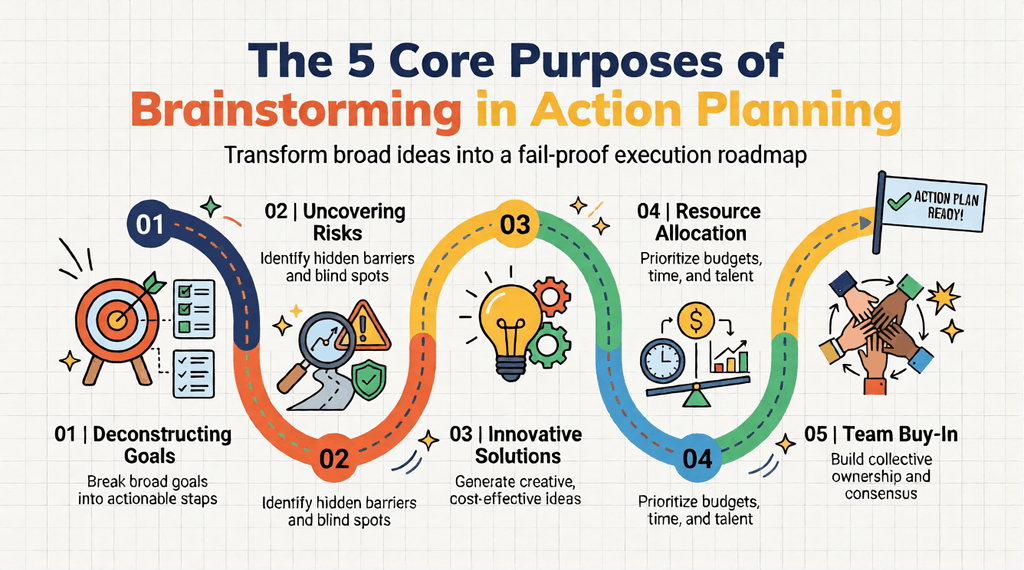
When done correctly, a brainstorming session is much more than just throwing ideas at a wall. It serves five distinct, critical functions in shaping your final roadmap.
1. Deconstructing Broad Goals into Actionable Steps
High-level goals like “Increase Q4 Revenue by 20%” or “Launch the New App Feature” are inspiring, but they are not executable. Brainstorming takes these massive, abstract objectives and forces the team to break them down into granular, assignable tasks. It translates the “what” into the “how.”
2. Uncovering Hidden Risks and Blind Spots
If a solo project manager writes an action plan, it will inherently contain blind spots. By bringing together diverse team members—from marketing, sales, tech, and customer support—you crowdsource your risk assessment. Someone from engineering might spot a technical roadblock that a marketing manager would never have anticipated, allowing you to build contingencies before the project even begins.
3. Generating Innovative, Cost-Effective Solutions
The golden rule of early brainstorming is “no bad ideas.” This psychological safety allows teams to bypass the standard “we’ve always done it this way” mentality. By encouraging unconventional thinking, your team is far more likely to discover faster, cheaper, or more effective workarounds to reach the same end goal.
4. Prioritizing Resource Allocation
Once all potential ideas and tasks are laid out on the table, the team can begin to identify the project’s “Critical Path.” Brainstorming helps you collaboratively decide which initiatives will have the highest impact, which require the most budget, and which “nice-to-have” tasks can be deprioritized or scrapped entirely.
5. Forging Psychological Buy-In from the Team
People support what they help create. If you simply hand an employee a list of tasks, they are merely accountable. But when stakeholders are actively involved in the brainstorming and problem-solving phase, they feel a deep sense of ownership over the final action plan. This buy-in is critical for maintaining momentum during difficult phases of the project.
Top Brainstorming Techniques for Action Plan Development
To get the best results, you need a framework. Here are three highly effective techniques to guide your next strategic session:
Mind Mapping
Mind mapping is perfect for visual thinkers. You place your core goal in the center of the board and draw branches outward for major categories, which then split into smaller sub-tasks. It visually connects your central objectives to the granular work required. (Tip: Formatting these structures digitally can be tedious. Check out SlideChef’s ready-to-use Mind Map presentation templates to digitize your session instantly).
SWOT Analysis (Strengths, Weaknesses, Opportunities, Threats)
Before you finalize a plan, you need to evaluate its feasibility. A SWOT analysis forces the team to look internally at what you do well and where you lack resources, while also looking externally at market opportunities and competitive threats. (You can easily present these findings using SlideChef’s premium SWOT templates).
Reverse Brainstorming
Instead of asking how to solve a problem, ask: “How could we ensure this project completely fails?” By proactively identifying every possible way to ruin the project, you naturally generate a list of the exact risks and pitfalls you need to avoid in your action plan.
How to Turn a Brainstorming Session into a Concrete Action Plan
A whiteboard full of sticky notes is not an action plan; it is just the raw material. To transition from the chaotic idea phase to a structured execution document, follow this simple 3-step funnel:
- Categorize & Group: Bundle similar ideas together. Group marketing ideas, technical requirements, and operational tasks into their respective buckets.
- Filter & Prioritize: Not every idea makes the final cut. Score the surviving concepts based on a matrix of “High Impact vs. Low Effort.” Discard the low-impact, high-effort distractions.
- Assign & Schedule: This is where the actual plan is born. Give every finalized task a clear owner, a strict deadline, and a measurable metric for success (KPI).
Once this funnel is complete, the absolute best way to present this finalized roadmap to your clients or executives is by transferring these tasks into a SlideChef Action Plan Presentation Template. This ensures your hard work looks polished, professional, and ready for immediate execution.
Ready to Execute Your Action Plan?
Brainstorming is the vital engine that transforms vague ambitions into a targeted, risk-averse, and highly effective roadmap. By taking the time to clarify your goals and align your team upfront, you ensure that every hour of execution is moving you in the right direction.
Don’t let your brilliant brainstorming session die on a messy whiteboard. Transform your team’s ideas into a professional, executive-ready roadmap in minutes. Browse SlideChef’s collection of Action Plan and Project Management presentation templates today and start executing with confidence.
About The Author





Related Blogs