Table of Contents
- Talk Track Explained: How to Create One for Presentations & Meetings
- What Is a Talk Track? Meaning, Definition & Purpose
- Why Is a Talk Track Important?
- What Are the Different Types of Talk Tracks?
- Talk Track vs. Script vs. Speaker Notes: What’s the Difference?
- How to Create an Effective Talk Track in 7 Simple Steps
- 10 Talk Track Examples for Presentations, Sales Calls & Business Meetings
- How to Create a Talk Track Template for Your Sales Team
- How to Use AI to Build and Improve Your Sales Talk Track
- Common Talk Track Mistakes to Avoid
- Tips to Deliver Your Talk Track with Confidence
- Final Thoughts: Make Every Conversation Count with a Good Talk Track
What Is a Talk Track? How to Create One with Examples for Presentations & Business Meetings
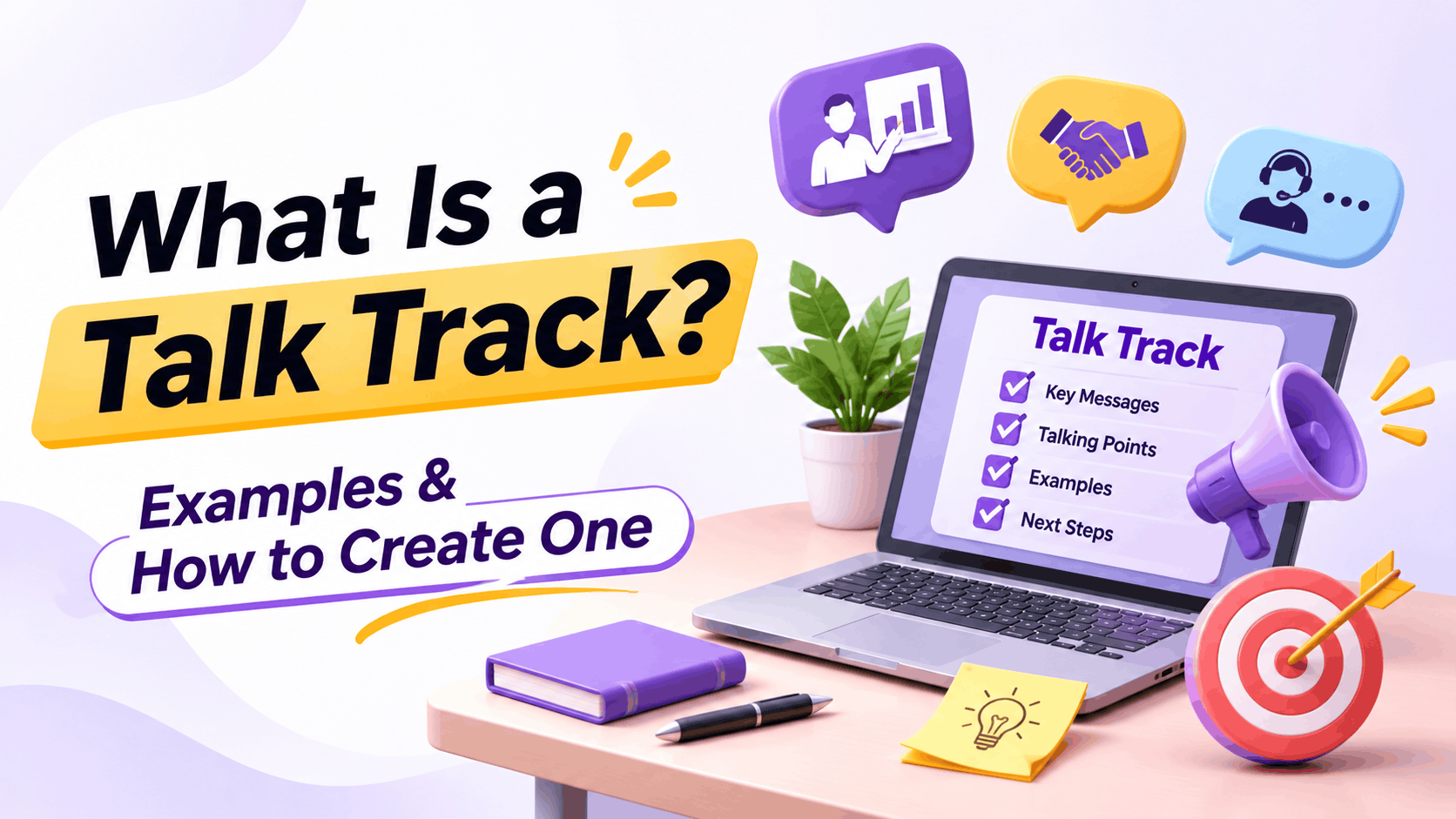
Talk Track Explained: How to Create One for Presentations & Meetings
A great presentation isn’t just about having impressive slides or knowing what to say. It’s about knowing how to connect your ideas, explain them clearly, and keep your audience interested from the first word to the last. That’s where a talk track makes all the difference.
Imagine you’re presenting a new business strategy, pitching a product to a potential client, or sharing project updates with your team. You may have all the right information, but without a clear flow, your message can easily get lost. A well-planned talk track gives your presentation direction, helps you stay focused, and makes your delivery sound more natural rather than rehearsed.
But what exactly is a talk track, and how do you create one that actually works? In this guide, we’ll explore the meaning of a talk track, its different types, practical examples for presentations and business meetings, and simple steps to build one. You’ll also learn how to pair your talking points with effective presentation slides to communicate your ideas with greater clarity and confidence.
What Is a Talk Track? Meaning, Definition & Purpose
A talk track is a planned sequence of key messages, talking points, and supporting information used to communicate an idea clearly and consistently. It gives speakers a direction to follow during presentations, business meetings, sales conversations, product demonstrations, and other professional discussions.
Think of it as a communication roadmap. Rather than figuring out what to say next while speaking, you have a clear structure that helps you move from one point to another without losing your audience’s attention.
For example, imagine you’re presenting a new business strategy to your leadership team. You wouldn’t want to jump straight into numbers, discuss marketing plans randomly, and then suddenly explain your objectives. Instead, a talk track helps you organize the conversation into a logical flow:
- Start with the objective: Explain what the presentation or discussion is about.
- Introduce the challenge: Highlight the problem, opportunity, or situation.
- Present your approach: Explain your ideas, recommendations, or proposed solution.
- Support your message: Use relevant data, examples, and insights.
- Close with action: Summarize the key takeaways and explain what should happen next.
The purpose of a talk track isn’t to memorize every word or deliver a presentation like a scripted speech. It’s to make sure your message stays focused while allowing you to speak naturally and adapt to your audience.
Whether you’re pitching a product, leading a team discussion, or presenting business results, a well-structured talk track helps you communicate with greater clarity, confidence, and consistency.
Why Is a Talk Track Important?
Have you ever started a presentation knowing exactly what you wanted to say, only to lose your flow halfway through? Maybe you spent too much time explaining one point, missed an important detail, or struggled to connect one slide with the next. It happens more often than you might think.
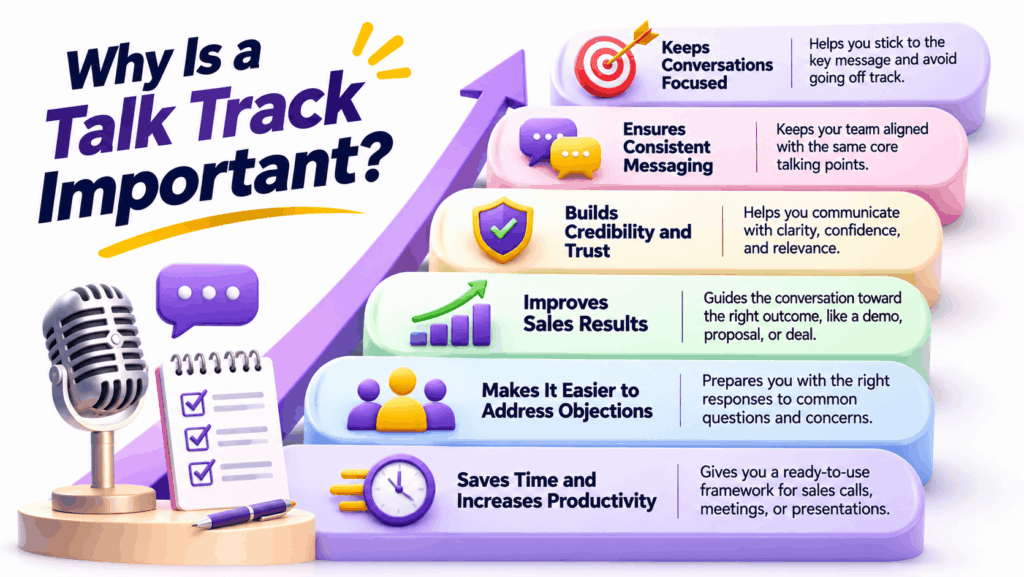
That’s one of the reasons a talk track is useful. It gives you a clear path to follow, so you can focus less on remembering what comes next and more on having a meaningful conversation with your audience.
Here are a few ways a well-prepared talk track can make a difference.
1. Keeps Your Message Clear and Focused
When you have several ideas to share, it’s easy to go off track. A talk track helps you identify the points that matter most and present them in an order that makes sense. Your audience gets the main message without having to piece together information themselves.
2. Helps You Speak with More Confidence
Walking into a meeting or presentation without knowing how to begin can be uncomfortable. Having your key talking points ready gives you a starting point and helps you move through the discussion without second-guessing every sentence.
3. Makes Your Communication More Consistent
This is particularly important for sales and marketing teams. When multiple people explain the same product, service, or business offering, a shared talk track helps everyone communicate the same core message without making every conversation sound identical.
4. Saves Time During Meetings and Presentations
A good talk track helps you avoid unnecessary explanations and keeps discussions focused on the agenda. Instead of spending 20 minutes explaining background information, you can get to the important decisions and next steps.
5. Keeps Your Audience Engaged
People don’t attend presentations just to listen to information being read aloud. They want to understand why something matters. A thoughtfully prepared talk track helps you connect facts, examples, and stories in a way that makes your message easier to follow.
Ultimately, a talk track isn’t about making every conversation perfect. It’s about being prepared enough to communicate naturally, get your point across, and leave your audience with something worth remembering.
What Are the Different Types of Talk Tracks?
Not every conversation has the same purpose, so using the same talk track for every situation doesn’t always work. A sales rep speaking with a potential customer needs a different approach from a manager presenting a business strategy or a marketing team introducing a new product.
That’s why talk tracks are usually tailored to the audience, the objective, and the stage of the conversation. Some are designed to guide sales calls, while others help teams communicate important messages, present ideas, or handle customer questions.
Let’s look at some common types of talk tracks and where each one fits.
1. Sales Talk Track
A sales talk track gives sales reps a clear direction for conversations with potential customers. It covers the key talking points they need to communicate, from introducing a product or service to understanding buyer pain points and explaining the value proposition.
Unlike a rigid sales script, a good sales talk track gives reps room to ask questions, listen to customer needs, and adapt their message during the conversation.
For example, during a sales call, a rep might start by understanding the buyer’s current challenges, explain how the product addresses those problems, and finish by suggesting a product demo or follow-up meeting.
2. Presentation Talk Track
A presentation talk track helps speakers organize what they want to say while moving through their slides. It connects each slide with a clear message, making it easier for the audience to follow the presentation.
For example, when presenting a quarterly business review, your talk track might cover business performance, key results, challenges, upcoming priorities, and the roadmap for the next quarter.
The goal is to make the presentation feel like a connected story rather than a collection of unrelated slides.
3. Business Meeting Talk Track
Business meeting talk tracks help managers, team leads, and stakeholders keep discussions focused. They outline the important topics, questions, decisions, and action items that need attention.
A project manager, for instance, might use a talk track to discuss project progress, highlight delays, address team concerns, and agree on the next steps.
It is particularly useful for recurring meetings where teams need to communicate updates consistently without making every discussion feel repetitive.
4. Marketing Talk Track
A marketing talk track helps teams communicate a consistent brand message across campaigns, product launches, presentations, and customer interactions.
It usually includes the target audience, key product benefits, customer pain points, brand positioning, and the message the team wants people to remember.
For example, when launching a new SaaS product, the marketing team can use a shared talk track to explain what the product does, who it is designed for, and why customers should consider it.
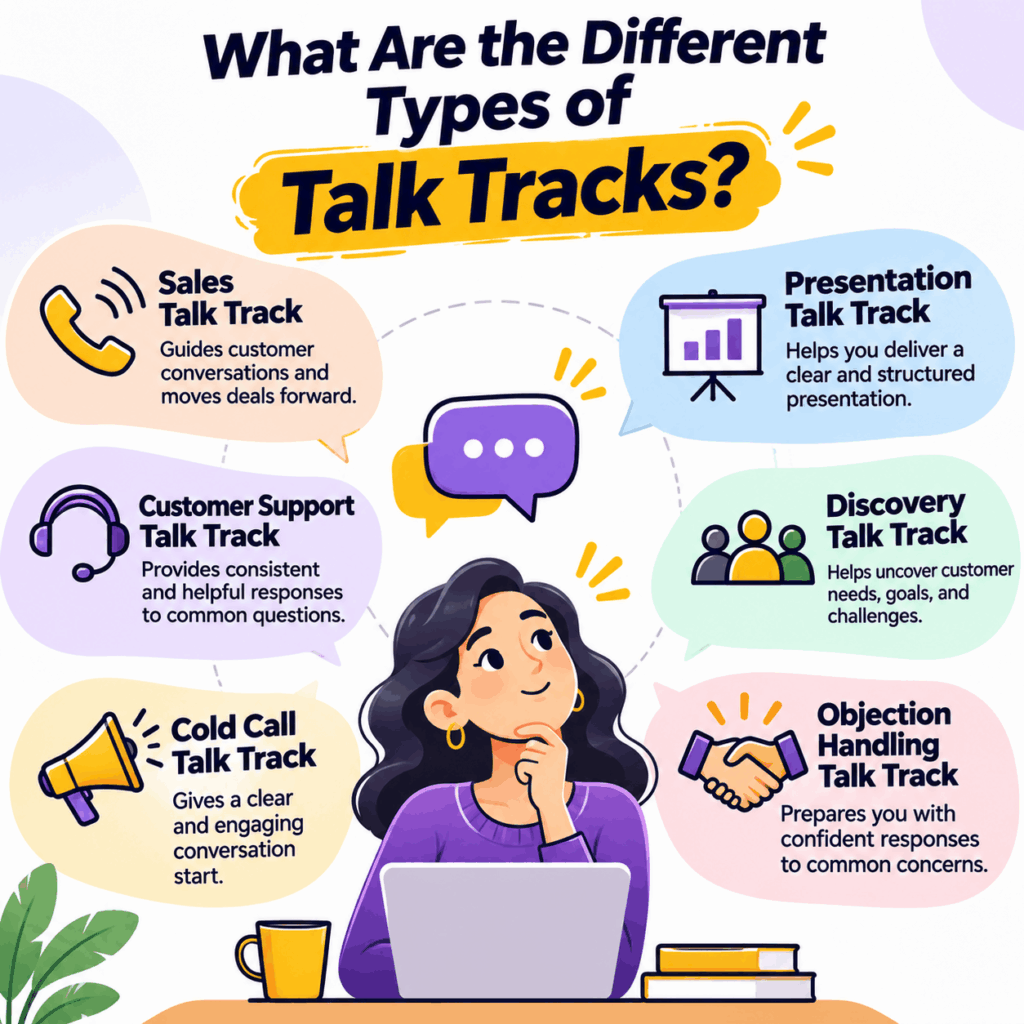
5. Executive Talk Track
An executive talk track is designed for high-level business discussions involving leadership teams, investors, and other important stakeholders.
It focuses on the bigger picture rather than every operational detail. Common talking points include business performance, strategic priorities, financial results, risks, growth opportunities, and future plans.
For example, a CEO presenting an annual business review might structure the discussion around achievements, challenges, market changes, and the company’s strategic roadmap.
6. Customer Service Talk Track
Customer service talk tracks help support representatives handle common customer questions, complaints, and concerns. They provide guidance on how to respond while allowing representatives to personalize each interaction.
For example, when a customer raises a concern about a delayed order, the representative can acknowledge the issue, explain the situation, offer a solution, and clarify what happens next.
These talk tracks are especially helpful for objection handling, difficult conversations, and maintaining a consistent customer experience.
A quick takeaway: Each type of talk track serves a different purpose, but they all have one thing in common: they help people communicate the right message without sounding overly rehearsed. The best approach is to build a flexible framework around your objective rather than rely on word-for-word scripts.
Talk Track vs. Script vs. Speaker Notes: What’s the Difference?
The terms talk track, script, and speaker notes are often used interchangeably, but they don’t mean exactly the same thing. All three help you prepare for a conversation or presentation, yet the way you use them can be quite different.
For example, a sales rep making a cold call might follow a sales script to introduce a product, while a sales talk track gives them talking points they can adapt based on the buyer’s responses. Similarly, someone delivering a PowerPoint presentation might use speaker notes to remember important details without putting everything on the slides.
Understanding the difference helps you choose the right approach for your sales process, business meetings, and presentations.
1. What Is a Talk Track?
A talk track is a flexible framework of key messages and talking points that guides a conversation. It gives you a clear idea of what to communicate without requiring you to follow exact words.
Sales teams often use talk tracks to explain a product or service, address customer pain points, communicate a value proposition, and handle common objections.
The biggest advantage is flexibility. You can adjust your message depending on the buyer, conversation, and situation while keeping your main points consistent.
2. What Is a Script?
A script is a more structured, word-for-word guide that tells you what to say during a particular conversation or interaction.
For example, a cold call sales script might include an opening introduction, a few qualification questions, a product pitch, common objection responses, and a call to action.
Scripts are useful when consistency is important, especially for new sales reps, customer support teams, and repetitive sales conversations. However, following one too rigidly can make interactions sound robotic.
3. What Are Speaker Notes?
Speaker notes are additional information written alongside presentation slides to help the presenter remember what to explain during a presentation.
They may include explanations, statistics, examples, transitions, reminders, or questions to ask the audience.
For instance, a slide might display three key business performance metrics, while the speaker notes explain what those numbers mean, why they matter, and how they relate to the company’s goals.
Speaker notes are particularly useful for PowerPoint presentations because they help presenters expand on the slide content without overcrowding the slides with text.
Talk Track vs. Script vs. Speaker Notes: Key Differences
| Comparison | Talk Track | Script | Speaker Notes |
|---|---|---|---|
| Main purpose | Guide communication | Provide exact wording | Support presentations |
| Structure | Flexible framework | Word-for-word | Supporting points |
| Flexibility | High | Usually low | Moderate to high |
| Common use | Sales calls, meetings, pitches | Cold calls, customer support | PowerPoint presentations |
| Focus | Key messages | Exact words | Slide explanations |
Which One Should You Use?
It depends on what you’re preparing for.
- Use a talk track when you want to guide a natural conversation while keeping your message consistent.
- Use a script when you need specific wording, particularly for repetitive interactions or a standardized sales process.
- Use speaker notes when you’re presenting slides and need additional details to support what your audience sees on screen.
In many situations, you can combine all three. For example, a sales presentation might have a talk track to guide the overall pitch, speaker notes to explain individual slides, and a short script for introducing the product or handling frequently asked questions.
The goal isn’t to choose one over the others. It’s to use the right level of preparation for the conversation you’re having.
How to Create an Effective Talk Track in 7 Simple Steps
Creating a good talk track doesn’t mean writing down everything you plan to say. It’s about knowing your audience, understanding what you want to communicate, and arranging your talking points in a way that feels natural.
Whether you’re preparing for a sales call, building a sales talk track for your team, or getting ready for a business presentation, the process starts with a clear message.
Here are seven steps to help you create a talk track that people can actually use.
1. Define Your Communication Goal
Before writing your first talking point, decide what you want to achieve. Are you trying to introduce a product, explain a business strategy, qualify a potential customer, or get approval for a new project?
Your objective will determine the direction of the entire conversation.
For example, if you’re preparing a sales talk track, your goal might be to understand a buyer’s challenges and demonstrate how your product or service can help. If you’re preparing a business presentation, you might want to explain a problem and convince stakeholders to support your proposed solution.
Keep your objective specific. A talk track becomes much easier to build when you know what you want your audience to understand or do.
2. Understand Your Target Audience
A good talk track starts with the person listening, not the person speaking. The same message won’t resonate with every audience.
Think about who you’re speaking to, what they already know, what they’re looking for, and what questions they might ask.
For a B2B sales conversation, for example, a business owner may care about cost savings, while an operations manager may be more interested in workflow improvements and automation.
Before creating your talking points, consider:
- Who is your ideal customer or audience?
- What are their biggest challenges and pain points?
- What information do they need before making a decision?
- What objections or concerns might they raise?
- What would make your message relevant to them?
The more you understand your audience, the easier it becomes to tailor your message instead of relying on generic talking points.
3. Identify Your Key Talking Points
Once you understand your objective and audience, list the main points you want to communicate. Don’t worry about writing complete sentences just yet. Start with the information that your audience genuinely needs to hear.
For a sales talk track, these might include:
- A brief introduction to your company or product.
- The customer’s specific pain points.
- Your product’s value proposition.
- Relevant features and benefits.
- Proof points, customer stories, or results.
- A clear next step or call to action.
For a presentation, your talking points might include the problem, supporting data, proposed solution, recommendations, and expected outcomes.
A useful tip: If you have too many talking points, ask yourself whether each one supports your main objective. Remove anything that doesn’t add meaningful value.
4. Structure Your Message with a Clear Beginning, Middle, and End
A collection of talking points isn’t necessarily a good talk track. You need to arrange them in an order that makes sense to your audience.
One simple framework is:
Beginning – Set the Context
Introduce the topic, explain why it matters, and give your audience a reason to pay attention.
Middle – Explain Your Main Message
Discuss the problem, share relevant information, present your solution, and support your points with examples or evidence.
End – Move Towards an Action
Summarize the important takeaways and explain what should happen next. This could be scheduling a demo, approving a proposal, making a decision, or discussing the next steps.
This structure works particularly well for business presentations, sales pitches, and important team meetings because it gives the conversation a natural direction.
5. Add Supporting Facts, Examples, and Stories
People are more likely to understand and remember a message when you support it with something concrete.
Instead of simply saying that your product improves productivity, explain how it helps customers save time, reduce manual work, or improve their existing workflow.
You can strengthen your talk track with:
- Real examples: Show how a similar customer solved a problem.
- Relevant statistics: Use data to support important claims.
- Customer stories: Explain how a product or service made a difference.
- Visuals: Use charts, diagrams, and infographics to simplify complex information.
For presentations, this is where your slides become particularly useful. Rather than filling every slide with paragraphs, use visual elements to support the points you’re discussing.
If you’re preparing a business pitch, strategy presentation, or sales deck, professionally designed PowerPoint templates from SlideChef can help you organize these ideas into clear, easy-to-follow slides.
6. Keep Your Talk Track Natural and Conversational
One common mistake is trying to write a talk track that sounds perfect on paper but feels unnatural when spoken aloud.
Remember, a talk track is not supposed to be a rigid script. It should give you enough direction to communicate confidently while leaving room for questions, follow-ups, and unexpected responses.
A few ways to make it sound more conversational:
- Use simple language instead of complicated business terminology.
- Write talking points rather than memorizing every sentence.
- Include open-ended questions to encourage a two-way conversation.
- Avoid repeating the same information unnecessarily.
- Adapt your message based on the audience’s reactions.
For sales reps, this is especially important. A potential customer should feel that they’re having a conversation with a salesperson who understands their needs, not someone reading from a sales script.
7. Practice, Refine, and Improve Your Delivery
Your first draft probably won’t be your final version. A talk track becomes more effective when you test it, listen to feedback, and refine the parts that aren’t working.
Try rehearsing it out loud, asking a colleague to play the role of a potential customer, or recording yourself delivering the presentation.
For sales teams, role-play exercises can help reps prepare for discovery calls, product demos, and common objection-handling situations.
You can also review call recordings and use conversation intelligence tools to identify where conversations lose momentum, which questions generate useful responses, and what messaging resonates with buyers.
Over time, these insights can help you improve your talk track based on actual conversations rather than assumptions.
A final tip: Don’t treat your talk track as a document you create once and forget. Customer needs change, products evolve, and new objections come up. Review it regularly and make adjustments so your message stays relevant.
10 Talk Track Examples for Presentations, Sales Calls & Business Meetings
Understanding how to create a talk track is one thing, but seeing how it works in real conversations makes it much easier to put into practice. The right approach depends on what you’re trying to achieve, who you’re speaking with, and where the conversation takes place.
For example, a sales rep preparing for a cold call needs a different set of talking points than a manager presenting quarterly results or a founder pitching a new business idea.
Below are 10 practical talk track examples you can adapt to different professional situations.
1. Sales Call Talk Track Example
A sales call talk track helps sales reps introduce their product or service, understand a potential customer’s needs, and explain how their solution can help.
Example:
“Hi [Name], thanks for taking the time to speak with me. I’d love to understand how your team currently manages [specific business challenge]. We work with businesses facing similar issues and help them improve their workflow through [product or service]. Before I walk you through what we offer, could you tell me a little about how you’re handling this today?”
Why it works: It starts a conversation rather than immediately pushing a sales pitch. The open-ended question also gives the salesperson an opportunity to understand the buyer’s pain points before introducing a solution.
2. Cold Call Talk Track Example
Cold calls are often the first interaction between a salesperson and a potential customer. You have very little time to capture attention, so your opening message needs to be short, relevant, and conversational.
Example:
“Hi [Name], this is [Your Name] from [Company]. I’ll keep this brief. We help [target audience] solve [specific problem] without [common frustration]. I was wondering if improving [relevant business outcome] is something your team is currently looking at?”
Why it works: The opening respects the prospect’s time, communicates a relevant value proposition, and gives them a reason to continue the conversation.
3. Discovery Call Talk Track Example
A discovery call is about understanding the customer’s situation before recommending a product or service. Instead of spending the entire call talking about your offering, focus on asking the right questions.
Example:
“Before we discuss possible solutions, I’d like to understand how your team currently handles [specific process]. What’s working well, and where are you experiencing the biggest challenges? Are there any tools or workflows you’ve already tried to address these issues?”
Why it works: It encourages a two-way conversation and helps sales reps qualify potential customers. The answers also provide useful information for tailoring the product demo or sales pitch.
4. Product Demo Talk Track Example
A product demo should show potential customers how a product works and, more importantly, how it solves their specific problems.
Example:
“Earlier, you mentioned that your team spends a lot of time managing tasks manually. Let me show you how this feature can simplify that process. Instead of switching between multiple tools, you can manage everything from one dashboard. Here’s how the workflow looks in practice.”
Why it works: Rather than listing product features, the salesperson connects each demonstration to a specific customer need.
5. Sales Objection Handling Talk Track Example
Not every potential customer will be ready to buy immediately. Some may have concerns about pricing, implementation, product features, or whether the solution is right for their business.
A good objection-handling talk track helps sales reps respond without becoming defensive or making the customer feel pressured.
Example:
Customer: “Your product seems interesting, but it’s more expensive than the alternative we’re considering.”
Sales Rep: “That’s completely understandable. Pricing is an important consideration. Could I ask what you’re comparing it against? I’d be happy to walk through the differences in features, support, and the overall value so you can decide which option makes the most sense for your team.”
Why it works: The rep acknowledges the concern, asks an open-ended question, and shifts the discussion towards value rather than immediately offering a discount.
6. Business Presentation Talk Track Example
When presenting a business strategy or proposal, your talk track should guide the audience through the main message rather than simply repeat the information displayed on the slides.
Example:
“Today, I’d like to walk you through our proposed growth strategy for the next quarter. We’ve identified three areas that need attention: customer acquisition, retention, and operational efficiency. I’ll explain where we currently stand, what opportunities we’ve identified, and the initiatives we believe can help us achieve our targets.”
Why it works: It establishes the purpose of the presentation and gives the audience a clear idea of what to expect.
7. Team Meeting Talk Track Example
Managers can use talk tracks to keep team meetings focused, communicate priorities, and make sure everyone understands their responsibilities.
Example:
“Before we get into this week’s tasks, let’s take a quick look at where we stand. We’ve completed most of the planned activities, but we’re running behind on two important deliverables. I’d like to understand what’s causing the delay, see where the team needs support, and agree on the priorities for the coming week.”
Why it works: It creates a structured discussion without making the meeting feel like a one-way announcement.
8. Product Launch Talk Track Example
A product launch talk track helps marketing, sales, and leadership teams communicate the same core message when introducing a new product or service.
Example:
“We’re excited to introduce [Product Name], designed to help [target audience] overcome [specific problem]. Unlike traditional approaches, our solution offers [key differentiator]. Today, we’ll walk through what makes it different, who can benefit from it, and how customers can get started.”
Why it works: It keeps the launch message consistent while highlighting the product’s audience, purpose, and value proposition.
9. Investor Pitch Talk Track Example
An investor pitch requires a clear story about the business opportunity, the problem being solved, and the potential for growth. A well-planned talk track helps founders communicate these points without overwhelming investors with details.
Example:
“We started [Company Name] after noticing a recurring problem in [industry]. Businesses were struggling with [specific pain point], and the existing solutions weren’t addressing it effectively. We developed [Product Name] to solve this challenge. Today, we’re serving [target market], and our next goal is to expand into [growth opportunity].”
Why it works: It connects the business problem, solution, market opportunity, and growth plans into a story investors can follow.
10. Performance Review Talk Track Example
Performance reviews often involve discussing achievements, challenges, and areas for improvement. A talk track helps managers approach these conversations constructively.
Example:
“Let’s start by looking at what you’ve accomplished this quarter. You’ve made good progress on [specific achievement], and I’d like to understand how you approached that work. We should also discuss a few areas where additional support or development could help you improve. Before we wrap up, let’s agree on some goals for the next review period.”
Why it works: It balances positive feedback with constructive discussion and gives employees an opportunity to share their perspective.
What Makes These Talk Track Examples Effective?
Although each example serves a different purpose, they follow a few common principles:
- Start with context: Give the listener a reason to pay attention.
- Focus on the audience: Address their questions, goals, and specific pain points.
- Keep the message conversational: Avoid sounding like you’re reading a rigid script.
- Support your points: Use relevant examples, data, and evidence.
- End with a clear next step: Make it easy for the listener to understand what happens next.
Use these examples as starting points rather than word-for-word scripts. A good talk track should always be adapted to the actual conversation, the people involved, and the outcome you’re trying to achieve.
How to Create a Talk Track Template for Your Sales Team
If your sales team handles multiple customer conversations every day, creating a talk track from scratch for every call isn’t practical. A reusable talk track template gives sales reps a starting point, keeps important messages consistent, and makes it easier to adapt conversations to different buyers.
A good template shouldn’t feel like a word-for-word sales script. Instead, it should provide a flexible framework that helps reps understand what to communicate at each stage of the sales process while leaving room for natural conversations.
Here’s a simple sales talk track template you can customize for your business.
1. Opening and Introduction
Start with a short introduction that establishes who you are and why you’re reaching out.
Template:
“Hi [Prospect Name], I’m [Your Name] from [Company Name]. We work with [Target Audience] to help them solve [Specific Problem]. I wanted to connect and learn a little about how your team currently handles [Relevant Process].”
2. Identify Customer Pain Points
Before pitching your product or service, understand what the buyer is struggling with. Use open-ended questions to encourage them to explain their challenges.
Template:
“How are you currently managing [Specific Task or Process]? Are there any challenges your team faces when it comes to [Pain Point]? What’s one thing you’d like to improve about your current approach?”
3. Present Your Value Proposition
Once you understand the customer’s needs, explain how your product or service can help. Focus on relevant benefits instead of listing every feature.
Template:
“Based on what you’ve shared, it sounds like [Specific Challenge] is something your team wants to improve. Our [Product or Service] helps businesses like yours by [Key Benefit], making it easier to [Desired Outcome].”
4. Handle Questions and Objections
Customers may have concerns about pricing, implementation, features, or switching from an existing solution. Prepare helpful objection responses, but avoid treating every objection as something you need to overcome immediately.
Template:
“That’s a fair concern. Could you tell me a little more about what’s making you hesitant? I can explain how our solution addresses that particular requirement and help you evaluate whether it’s the right fit.”
5. Close with a Clear Next Step
A good sales conversation should end with a clear direction. Depending on the buyer’s interest, that could mean scheduling a product demo, sharing a proposal, or arranging another sales call.
Template:
“Based on our conversation, I think it would be useful to show you how this works in practice. Would you be available for a quick demo sometime this week?”
A Simple Sales Talk Track Template at a Glance
| Sales stage | What to communicate | Objective |
|---|---|---|
| Introduction | Who you are and why you’re calling | Build initial interest |
| Discovery | Questions about customer pain points | Understand customer needs |
| Value proposition | How your product helps | Demonstrate relevance |
| Objection handling | Address concerns and questions | Build confidence |
| Closing | Agree on the next step | Move the sales process forward |
Tip: Save this framework in your CRM or sales playbook so your entire sales team can access it. Reps can personalize the talking points based on the buyer’s industry, role, specific pain points, and stage in the sales process.
You can also use call recordings and conversation analytics to identify which messages resonate with potential customers and refine your talk track over time.
How to Use AI to Build and Improve Your Sales Talk Track
Creating a sales talk track is no longer just about writing a few talking points and sharing them with your sales team. With AI-powered sales tools becoming more common, businesses can now research potential customers, personalize messages, analyze sales conversations, and improve their talk tracks using real customer interactions.
For sales teams handling multiple prospects, this can save time and make conversations more relevant. Instead of relying on the same sales script for every buyer, AI can help reps adjust their messaging based on customer needs, industry, previous interactions, and sales call outcomes.
Here are a few practical ways to use AI to improve your sales talk track.
1. Use AI to Research Your Target Audience
Before reaching out to a potential customer, sales reps need to understand who they’re speaking with. AI tools can help summarize information about a company’s industry, business model, target market, and possible challenges.
For example, if you’re selling a SaaS product to an e-commerce business, AI can help identify common challenges around inventory management, customer retention, and order processing. You can use these insights to prepare more relevant opening messages and discovery questions.
2. Generate Personalized Sales Talk Tracks
Writing individual sales scripts for every prospect can take considerable time. AI writing tools can help create initial talk track drafts based on your product, ideal customer profile (ICP), buyer persona, and communication goals.
You can provide a prompt such as:
“Create a conversational B2B sales talk track for a SaaS product targeting small business owners. Include an opening message, three discovery questions, a value proposition, common objections, and a clear call to action. Keep the language natural and avoid sounding overly promotional.”
The generated output gives sales reps a starting point that they can refine before using it in actual sales conversations.
3. Improve Objection Handling with AI
Handling objections is one of the more challenging parts of a sales conversation. Customers may question pricing, compare competitors, express concerns about implementation, or simply say they aren’t ready to make a decision.
AI can help sales teams prepare different objection responses and practice how to handle these situations.
For example, you can ask AI to generate responses to common objections such as:
- “Your product is too expensive.”
- “We’re already using another solution.”
- “We don’t need this right now.”
- “Can you send me more information?”
The important thing is to use these responses as guidance rather than memorizing them word for word. A good salesperson should understand the concern before suggesting a solution.
4. Analyze Sales Calls and Conversation Recordings
Some AI-powered conversation intelligence platforms can analyze recorded sales calls and identify useful patterns in customer conversations.
These tools can help sales managers understand:
- Which talking points generate the most engagement.
- What objections come up repeatedly.
- Which questions lead to meaningful customer discussions.
- Where sales reps struggle to explain the product.
- What messaging appears to move conversations forward.
These insights can help teams refine their sales talk track based on actual conversations instead of relying entirely on assumptions.
5. Connect Your Talk Track with CRM and Sales Automation
Your CRM can become a useful place to organize and maintain sales messaging. By connecting talk track resources with your sales workflow, reps can access relevant talking points at different stages of the sales process.
For example, a sales team might maintain separate talk tracks for cold calls, discovery calls, product demos, follow-ups, and closing conversations.
With the help of marketing automation and AI-powered workflows, teams can also use customer information and previous interactions to make their communication more relevant.
6. Test, Review, and Refine Your Talk Track
AI-generated content isn’t automatically a good sales talk track. It still needs to be reviewed, tested, and improved based on how real customers respond.
Encourage your sales team to review call recordings, track common objections, and compare different messaging approaches. Pay attention to which opening questions generate better conversations and which value propositions are more relevant to your target buyers.
Over time, these improvements can turn an ordinary sales script into a more adaptable and effective sales playbook.
One thing to remember: AI should support your sales team, not replace genuine conversations. The best talk tracks combine useful data, relevant messaging, and the salesperson’s ability to listen and respond naturally.
A well-crafted framework gives your reps direction, while human judgment helps them build trust with potential customers.
Common Talk Track Mistakes to Avoid
Creating a talk track can make presentations and sales conversations more organized, but having a framework doesn’t automatically make every interaction successful. Sometimes, the way you prepare or deliver your talking points can make the conversation feel forced, repetitive, or disconnected from what your audience actually wants to hear.
This is particularly common in B2B sales, where reps may focus too much on delivering their sales script instead of understanding the buyer’s needs.
Here are some common mistakes to watch out for when creating and using a talk track.
1. Making Your Talk Track Sound Like a Robotic Script
One of the biggest mistakes is memorizing every sentence and delivering it exactly as written. This can make sales calls and presentations sound unnatural.
A talk track should provide direction, not dictate every word. Use key talking points as a guide and allow yourself to adjust your language based on the conversation.
2. Talking Too Much About Your Product or Service
It’s easy to get carried away explaining product features, especially when you’re confident about what you’re selling. But potential customers are usually more interested in how your solution addresses their specific pain points.
Instead of listing every feature, focus on the benefits that matter to the buyer. Ask questions, understand their challenges, and connect your value proposition to their actual needs.
3. Ignoring Customer Questions and Objections
A sales talk track shouldn’t prevent reps from listening to customers. If someone raises a concern about pricing or asks about a particular feature, continuing with the original sales script can make the conversation feel one-sided.
Take time to understand the question, acknowledge the concern, and provide a relevant response before moving forward.
4. Including Too Many Talking Points
Trying to cover everything in one conversation can overwhelm your audience. A lengthy talk track filled with unnecessary details makes it harder for people to identify your main message.
Prioritize a few important talking points and keep supporting information ready when needed. Your objective should be to communicate what matters, not say everything you know.
5. Using the Same Talk Track for Every Buyer
Different buyers have different priorities. A startup founder may be interested in affordability and scalability, while an enterprise decision-maker may focus on security, integration, and operational efficiency.
Using the same message for everyone can make your communication feel generic. Tailor your talk track based on the customer’s industry, role, requirements, and stage in the sales process.
6. Forgetting to Include a Clear Call to Action
A conversation can go well, but without a clear next step, it may not move anywhere.
Whether you’re presenting a business proposal or conducting a sales call, make sure your audience knows what happens next. This could mean scheduling a product demo, requesting feedback, sharing a proposal, or agreeing on a follow-up meeting.
7. Never Updating Your Talk Track
Customer expectations, market conditions, and product offerings change over time. A sales talk track that worked six months ago may no longer address the questions buyers are asking today.
Review your talk track regularly using feedback from sales reps, customer interactions, CRM data, and call recordings. Remove outdated information and update objection responses whenever new patterns emerge.
The takeaway: A good talk track should make communication easier, not turn it into a performance. Keep your message focused, listen to your audience, and treat your framework as something you can continuously improve rather than a rigid set of instructions.
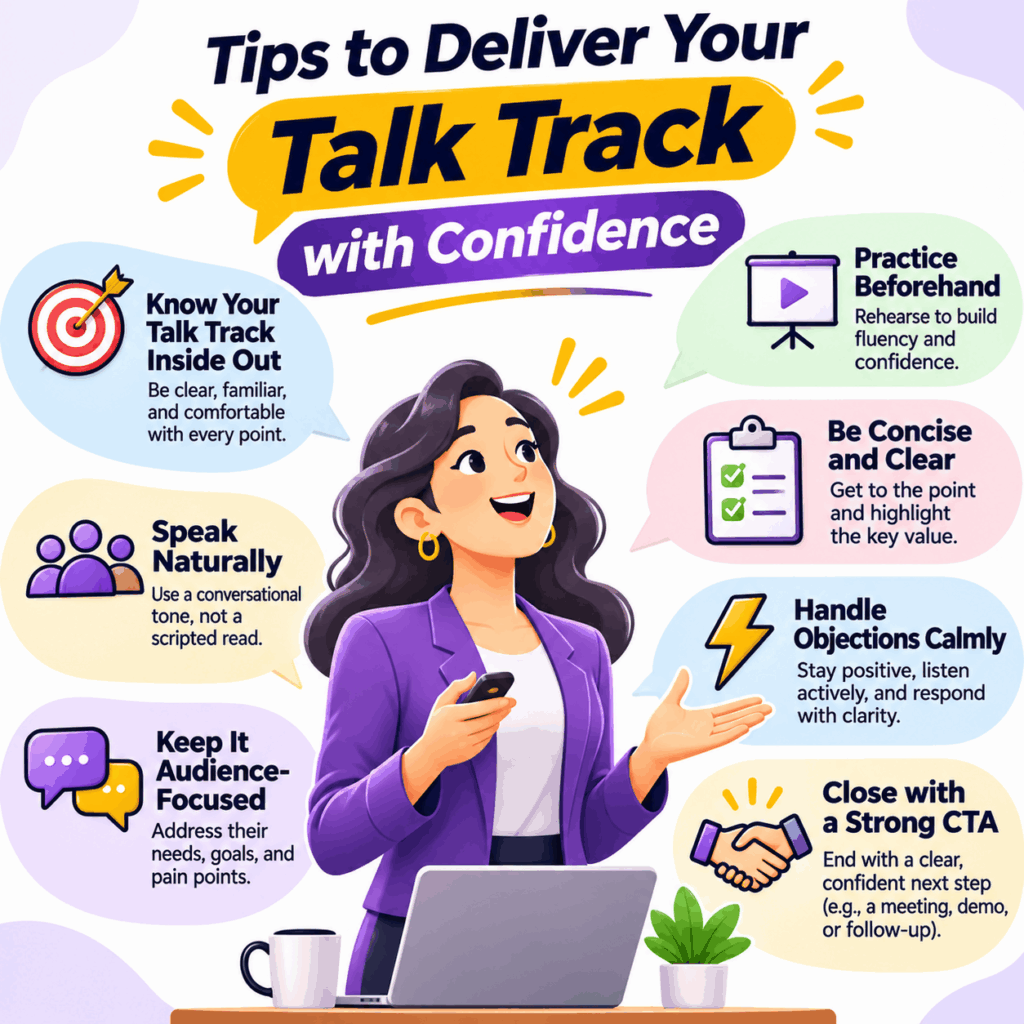
Tips to Deliver Your Talk Track with Confidence
Even a well-written talk track won’t make much difference if you struggle to deliver it naturally. Whether you’re presenting a business strategy, speaking with a potential customer, or leading a sales meeting, the way you communicate matters just as much as the message itself.
The goal isn’t to remember every sentence or deliver a flawless speech. It’s to understand your key talking points well enough that you can speak comfortably, respond to questions, and keep the conversation moving.
Here are some practical ways to improve your delivery.
1. Rehearse Your Main Talking Points
Before an important presentation or sales call, spend some time going through your talk track. You don’t need to memorize it word for word. Instead, familiarize yourself with the order of your key points and the message you want to communicate.
Try explaining your ideas aloud rather than silently reading through your notes. This helps you identify awkward phrases, missing information, and areas where you need a smoother transition.
2. Use Natural Language and Avoid Overly Formal Scripts
Your audience should feel like they’re having a conversation with you, not listening to someone read a prepared document.
Use simple, familiar language and explain complicated ideas in a way people can easily understand. In sales conversations, avoid relying too heavily on industry jargon or repeating the same promotional phrases.
A conversational approach makes it easier to build trust and encourage people to participate.
3. Maintain Eye Contact and Positive Body Language
When delivering a presentation, your body language can influence how your message is received. Maintaining eye contact, using natural hand gestures, and standing comfortably can make you appear more confident and approachable.
If you’re presenting online, look towards your camera occasionally instead of constantly looking at your screen or notes.
4. Control Your Speaking Pace and Tone
Speaking too quickly can make it difficult for your audience to follow your ideas. On the other hand, speaking too slowly can make your presentation lose momentum.
Pay attention to your pace and pause briefly after important points. Vary your tone when explaining key ideas, sharing examples, or highlighting important information.
A little variation makes your delivery more engaging and helps important messages stand out.
5. Don’t Read Directly from Your Presentation Slides
Your PowerPoint slides should support what you’re saying, not replace your explanation.
Instead of putting long paragraphs on every slide, highlight important points using short text, charts, diagrams, and relevant visuals. Use speaker notes to keep additional explanations and reminders handy.
For example, if you’re presenting a sales strategy, your slide might show the key stages of the sales funnel while your talk track explains what happens at each stage.
If you’re preparing a business presentation, sales pitch, or project update, SlideChef’s PowerPoint templates can help you organize information into visually clear slides without starting from a blank page.
6. Adapt Your Message Based on Audience Reactions
Not every presentation or sales call will go exactly as planned. Someone might ask an unexpected question, raise an objection, or need more explanation about a particular point.
Don’t feel pressured to stick to your original talk track when the conversation takes a different direction.
Listen carefully, address the concern, and adjust your explanation when necessary. This flexibility is especially important during discovery calls, product demos, and discussions with business stakeholders.
7. Ask Questions and Encourage Participation
A talk track shouldn’t turn every interaction into a one-way conversation. Give your audience opportunities to ask questions, share opinions, and explain their concerns.
For example, during a business presentation, you might ask, “Does this approach address the challenges your team is currently facing?”
During a sales call, an open-ended question such as “What would you most like to improve about your current process?” can help you understand the buyer’s priorities.
These small interactions make conversations more engaging and help you build a stronger connection with your audience.
Remember: Confidence doesn’t come from having the perfect words prepared. It comes from understanding your message, knowing your audience, and being comfortable enough to adapt when things don’t go exactly as planned.
Final Thoughts: Make Every Conversation Count with a Good Talk Track
A good talk track gives you more than a list of things to say. It helps you organize your thoughts, communicate your message clearly, and keep conversations focused on what matters.
Whether you’re preparing for a sales call, presenting a business strategy, or leading an important team meeting, the key is to find a balance between preparation and flexibility. Know your talking points, understand your audience, and be ready to adjust your approach as the conversation develops.
And when your ideas need visual support, the right presentation can make them even easier to understand. Explore SlideChef’s PowerPoint templates and infographic slides to turn your talking points into presentations that look as clear and professional as the message you’re delivering.
What Is an Example of a Good Talk Track?
A good talk track clearly introduces a topic, communicates the most important points, and guides the conversation towards a specific outcome.
For example, a sales rep speaking with a potential customer might start by asking about their current challenges, explain how their product addresses those pain points, and suggest a product demo as the next step. The conversation follows a clear direction without sounding like a memorized sales script
How Long Should a Talk Track Be?
There is no fixed length for a talk track. It depends on the purpose of the conversation, the audience, and how much information you need to communicate.
A cold call talk track might only need a few key talking points, while a business presentation or investor pitch may require a more detailed framework. The important thing is to include enough information to communicate your message without overwhelming your audience.
Is a Talk Track the Same as a Sales Script?
No. A sales script usually provides specific, word-for-word instructions for what a salesperson should say. A sales talk track is more flexible and focuses on the key messages, questions, and talking points that should guide the conversation.
Sales reps can use a talk track to maintain consistency while adapting their responses based on the buyer’s questions and needs.
How Do You Write a Talk Track for a Sales Call?
Start by identifying the purpose of the sales call and researching your target customer. Then prepare an opening message, relevant discovery questions, your product’s value proposition, responses to common objections, and a clear call to action.
Keep the language conversational and leave room for the potential customer to share their challenges. Avoid treating the talk track as a rigid script.
About The Author





Related Blogs