
What is a Pitch Deck? How to Create a Pitch Deck to Win Over Investors?

Easy Guide to Create a Pitch Deck?
A pitch deck is a concise, highly visual presentation—typically 10 to 15 slides—used by entrepreneurs and startup founders to communicate their core business model, market opportunity, and funding requirements to potential investors.
For any startup looking to raise capital, this document is often the very first impression you will make on a venture capitalist or angel investor. It serves as the critical bridge between your initial vision and securing the financial backing needed to scale. However, distilling a comprehensive business plan and years of hard work into a skimmable, compelling narrative is incredibly challenging. In this guide, we will break down the exact meaning and purpose of a pitch deck, outline the proven slide structure that investors expect to see, and provide you with ready-to-use presentation templates so you can focus on perfecting your pitch rather than building layouts from scratch.
What is the Purpose of a Pitch Deck?
While it is easy to assume that a pitch deck is designed to secure a massive investment check on the spot, its actual purpose is much more focused: the primary goal of a pitch deck is simply to get to the next meeting. Venture capitalists and angel investors review hundreds of pitches every month, meaning they use these initial presentations primarily as a fast filtering mechanism. A successful deck generates enough intrigue, establishes enough credibility, and clearly defines the market opportunity so that an investor wants to invite you back for a deeper, more rigorous due diligence conversation.
Beyond securing capital, the process of building a pitch deck serves a crucial secondary purpose for the startup founders themselves. It forces you to step away from the daily operational chaos of building a product and distill your entire business into a clear, compelling, and simplified narrative. By condensing complex ideas, market sizing, and financial projections into a highly visual presentation, you clarify your own strategic thinking and ensure your entire team is perfectly aligned on the company’s trajectory.
How to Make a Pitch Deck That Gets Funded?
While every startup is unique, the psychology of investing is remarkably consistent. Venture capitalists and angel investors review thousands of presentations, and over time, they have come to expect a very specific narrative arc. Deviating too far from this standard format forces investors to work harder to understand your business, which often leads to a quick rejection.
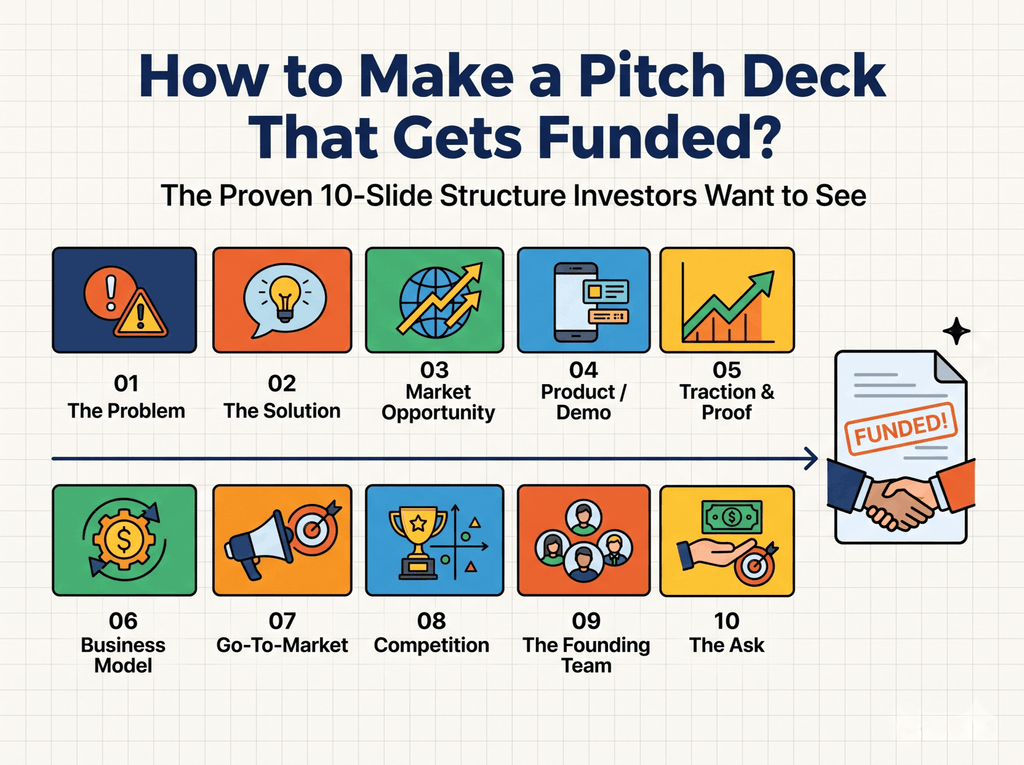
To maximize your chances of securing funding, you should follow the golden “10-Slide Structure.” This framework logically guides the audience from the initial pain point all the way to your financial request, ensuring you cover every critical business metric along the way.
1. The Problem
Never start by talking about yourself or your product; start with the pain. Clearly define a massive, urgent problem or a highly inefficient status quo that a specific group of people is currently facing. If the investor does not believe the problem is real or painful enough, they will not care about your solution.
2. The Solution
Introduce your product or service as the ultimate hero. Explain concisely how your startup directly resolves the problem you just outlined on the previous slide. Keep this high-level and focused on the value proposition rather than getting bogged down in technical features.
3. Market Opportunity
Investors are looking for businesses that can achieve massive scale. Use this slide to define your Total Addressable Market (TAM). You need to prove with credible data that the market is large enough—and growing fast enough—to generate a venture-scale return on their investment.
4. Product / Demo
Show, do not just tell. Provide a glimpse of your actual product in action. Use high-quality screenshots, a short embedded video, or a clean mockup to demonstrate the user interface and the core functionality. This proves you have moved beyond the idea phase and have built something tangible.
5. Traction & Proof
This is often the most important slide in the deck. Investors want proof that the market actually wants what you are building. Highlight your early momentum through hard metrics: Monthly Recurring Revenue (MRR), active users, customer acquisition costs, waitlist numbers, or major letters of intent (LOIs).
6. Business Model
How does your company actually make money? Break down your pricing strategy, revenue streams, and unit economics. Whether it is a SaaS subscription model, a one-time hardware purchase, or a marketplace transaction fee, your path to profitability must be crystal clear.
7. Go-To-Market (GTM) Strategy
Having a great product is useless if nobody knows it exists. Explain exactly how you plan to acquire customers at scale. Outline your primary marketing channels, sales strategy, and any early growth hacks you are utilizing to build your user base cost-effectively.
8. The Competition
Do not ever claim that you have “no competition”—investors know that is false. Map out the competitive landscape, acknowledging the established players. Then, clearly highlight your unique competitive advantage or “moat” that explains why customers will choose you over the alternatives.
9. The Founding Team
Investors fund people, not just ideas. Highlight the core members of your team, focusing specifically on past successes, relevant industry experience, and technical expertise. You must answer the implicit question: Why are you the absolute best people in the world to execute this specific vision?
10. The Ask
End with a clear, specific request. State exactly how much capital you are raising (e.g., “We are raising a $1.5M Seed round”). Crucially, you must explain exactly how you will deploy these funds and what specific milestones (e.g., “10,000 active users” or “cash-flow positive”) this runway will help you achieve.
Best Practices for a Winning Pitch Presentation
Having the right 10-slide structure is only half the battle; how you design and deliver that information dictates whether investors stay engaged or start checking their phones. To ensure your presentation leaves a lasting, professional impression, keep these core best practices in mind:
- Embrace the “One Idea Per Slide” Rule: Do not force your audience to process your market size, competitive advantage, and financial projections all on the same screen. Each slide should have a single, clear takeaway that can be understood in under five seconds.
- Keep It Under 15 Slides: Venture capitalists have notoriously short attention spans. If you cannot explain your business model in 10 to 15 slides, it signals that your strategy might be too complex or unfocused. Save the hyper-detailed spreadsheets and technical architecture diagrams for the due diligence phase.
- Prioritize Visuals Over Text: Never use walls of text. Humans cannot simultaneously read dense paragraphs and listen to you speak. Use bold metrics, clean charts, and high-quality graphics to tell your story, allowing your verbal pitch to provide the necessary context.
- Don’t Build from Scratch: As a founder, your time is your most valuable asset. You should be spending it refining your business strategy, talking to customers, and practicing your delivery—not agonizing over margin alignments and color palettes. Building visual layouts from the ground up drains hours of productivity. Utilizing premium, pre-formatted presentation templates from SlideChef gives you a massive advantage, allowing you to plug your data into beautifully designed, investor-ready slides in a fraction of the time.
Best Pitch Deck Template Examples
Now that you understand the anatomy of a winning presentation, it is time to start building yours. To help you bypass the tedious design process and focus entirely on your business narrative, we have curated a list of the best ready-to-use pitch deck templates. These premium SlideChef designs are specifically structured to capture investor attention, logically follow the proven 10-slide framework, and can be fully customized with your data in minutes. Explore these top examples below to find the perfect visual style for your next investor meeting:
Accounting Firm Business Plan Template
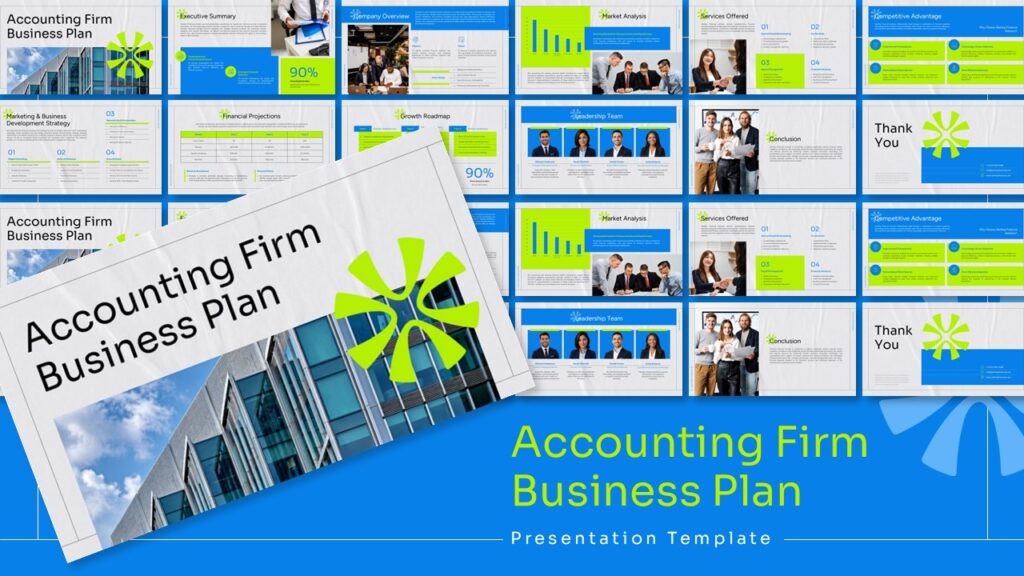
Designed specifically for B2B service providers and financial startups, this 13-slide presentation template offers a highly polished, corporate aesthetic. The deck utilizes a high-contrast blue and vibrant green color palette to visually convey both institutional trust and modern growth. It comes pre-structured with all the critical narrative sections investors look for, featuring ready-made layouts for your Executive Summary, Market Analysis (including built-in bar charts), Financial Projections, and a photo-based Leadership Team slide. This particular design is perfect for service-oriented founders who need to present a rigorous, numbers-driven business model with absolute clarity.
Import and Export Business Plan Template

If you are building a logistics, supply chain, or global trade startup, this template keeps your presentation simple and strictly on-topic. It uses a bright orange and blue color scheme paired with background images of cargo ships and shipping containers. The deck includes easy-to-read, pre-formatted slides for standard sections like your “Executive Summary,” “Products & Services,” and “Market Analysis”. To help you easily explain complex international logistics to investors, it also features specialized layouts specifically for “Risk Analysis & Compliance” and “Business Strategy & Operations.
Company Overview Template by SlideChef
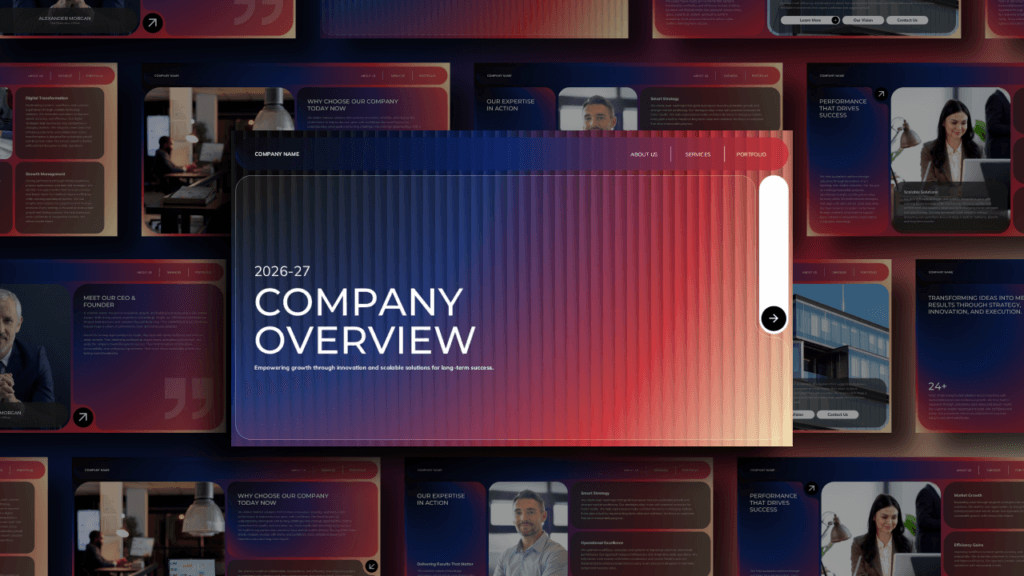
If you want a bold, modern look, this Company Overview template by SlideChef features a striking dark-mode aesthetic with a deep blue to vibrant red gradient. What makes this design unique is its website-style layout, complete with a top navigation bar featuring tabs for “About Us,” “Services,” and “Portfolio”. It provides clean, photo-centric slides for introducing your leadership team (“Meet our CEO”), highlighting your core strengths (“Our Expertise in Action”), and showcasing your wins (“Performance That Drives Success”). This sleek, high-end design is a perfect match for tech startups, creative agencies, or any founder looking to make a strong visual statement.
Investor Pitch Deck by SlideBazaar
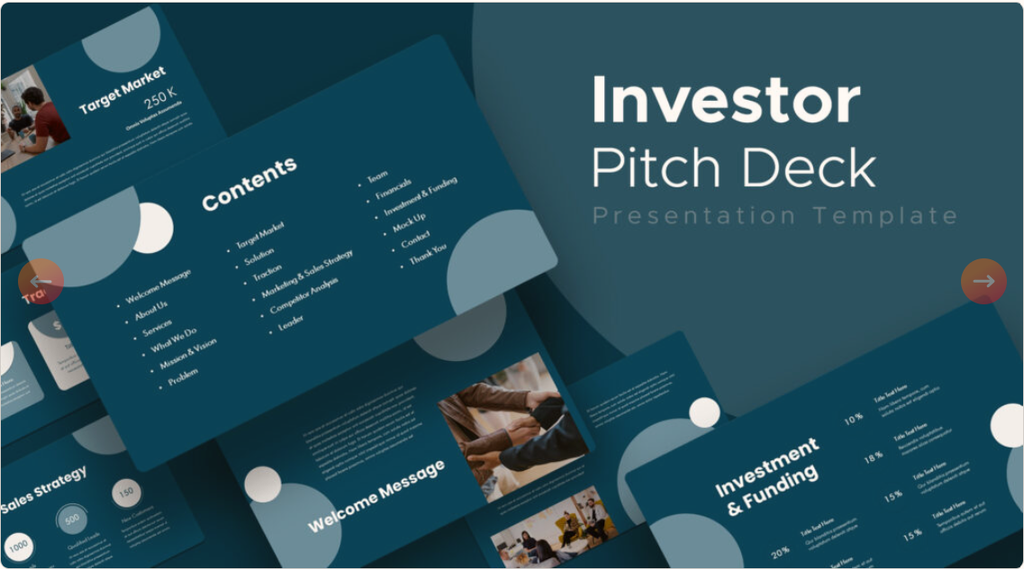
If you want a presentation that balances modern design with a highly professional tone, the Investor Pitch Deck by SlideBazaar is an excellent choice. This template features a sophisticated deep teal background accented with clean, geometric circles and high-quality image placements. It is incredibly comprehensive, offering a structured narrative flow that covers every essential startup topic—with dedicated slides for your “Target Market,” “Sales Strategy,” and the critical “Investment & Funding” ask. This deck is ideal for founders who need a complete, ready-made outline that guides investors smoothly from the initial problem statement all the way to the final financial breakdown.
Finance Pitch Deck Prezi Style Template by SlideBazaar
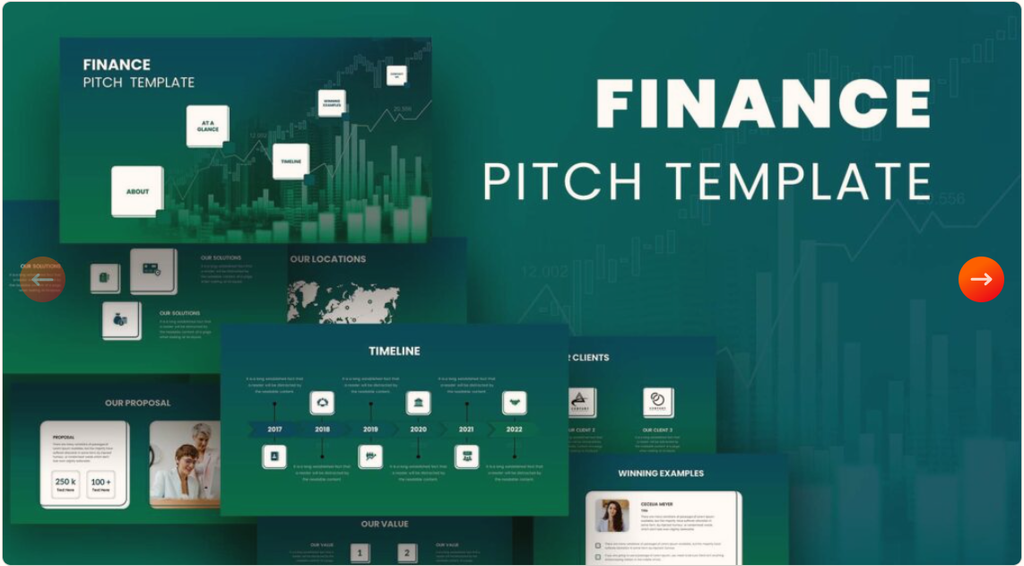
For fintech startups and financial institutions, this template offers a dynamic visual experience inspired by Prezi’s node-based navigation structure. Set against a professional dark green background that features subtle stock market chart motifs, the design immediately establishes a strong financial theme. It includes ready-to-use slide layouts for critical business sections, including a chronological “Timeline,” a global “Our Locations” map, an “Our Proposal” overview, and a “Clients” slide for social proof. The unique floating-box aesthetic allows founders to present complex financial data and business solutions in a highly engaging, modern format.
AI Tech Pitch Deck Template by Slidesdepot

For startups building the future in artificial intelligence, spatial computing, or deep tech, the AI Tech Pitch Deck by Slidesdepot makes a massive visual statement. This template completely abandons the traditional corporate look in favor of a striking, futuristic dark-mode aesthetic, utilizing deep black backgrounds paired with high-contrast neon pink, electric blue, and lime green accents. It features bold, cyber-inspired 3D imagery—such as the prominent VR headset render—that perfectly matches the disruptive energy of an innovative tech company. Beyond the eye-catching visuals, it includes pre-built layouts for complex startup topics like “Business Challenges & AI Solutions,” “Product Development,” and a detailed “Project Roadmap.” This is the ideal deck for founders who need their presentation design to feel just as cutting-edge as the technology they are building.
Stop Tweaking, Start Pitching
Let’s be real: venture capitalists are writing checks for your traction, your team, and your market size—not your ability to manually align text boxes at 2 AM. Your sole objective with this presentation is to tell a story so tight and compelling that investors have no choice but to schedule a follow-up meeting. By adhering to the lean, 10-slide framework, you cut out the fluff and hand them exactly the data they are actively hunting for.
Don’t drain any more of your valuable runway playing graphic designer. Grab a premium, pre-formatted presentation from SlideChef, drop in your hard-earned metrics, and get back to what you actually do best: building a scalable business. You already have the vision and the roadmap—now go secure the capital.
How long should a pitch deck be?
A standard pitch deck should be between 10 and 15 slides. Venture capitalists review thousands of pitches a year and have very short attention spans, so your goal is to deliver a concise, high-level overview of your business rather than a granular technical breakdown. If your deck exceeds 15 slides, it often signals a lack of focus.
What is the difference between a pitch deck and a business plan?
A pitch deck is a highly visual, 10-to-15-slide presentation designed to grab an investor’s attention and secure a meeting. A business plan is a comprehensive, text-heavy document (often 20-50 pages) that details every operational, financial, and strategic aspect of your company. You use the pitch deck to generate interest, and you provide the business plan later during the due diligence phase.
Should I send my pitch deck to investors before the meeting?
Yes, but you should ideally have two different versions of your deck. A “reading deck” sent via email before the meeting can include slightly more text so it makes sense without your verbal explanation. Your “presentation deck,” which you use live in the room, should be highly visual with minimal text so the investors focus on you rather than reading the screen.
What is the most important slide in a pitch deck?
While the entire narrative matters, the “Traction & Proof” slide is often heavily scrutinized. Investors want to see hard evidence that the market actually wants your solution. Demonstrating month-over-month revenue growth, active user engagement, or significant letters of intent (LOIs) is the fastest way to prove your startup is a viable investment.
About The Author





Related Blogs